DATA on Orthodox Churches WORLWIDE
MENSCHENWUERDE UND FRIEDEN statt VERSPOTTUNGSFREIHEIT UND WELTWEITER BUEGERKRIEG ???
see also (in German):
Christliche Verantwortung in der Welt - zu Politik und Krieg
 !!! MASSAKER
an der ZIVILBEVÖLKERUNG kommen aus der LUFT !!!
!!! MASSAKER
an der ZIVILBEVÖLKERUNG kommen aus der LUFT !!!
Steinmeier/Struck regieren gegen die Mehrheit
der Deutschen
77 % der deutschen Bevölkerung gegen "Kanonenboot-Politik am
Hindukusch"


Andachten für Opfer des NATO-Angriffs auf Serbien
(BELGRAD) Am vergangenen Samstag wurden, mit dem Segen des Serbischen
Patriarchen Pavle I.,
in allen serbischen orthodoxen Kirchen Totenandachten für
Opfer des NATO-Bombardements von 1999 zelebriert.
In Belgrad zelebrierte Vikarbischof Atanasije von Hvosno die Totenandacht
in der dortigen Markuskirche.
Im NATO-Angriff auf Serbien, beziehungsweise das damals noch existierende
Staatenbündnis Serbien-Montenegro,
starben rund 2.500 Zivilisten,
darunter 89 Kinder.
Auch 1.002 Soldaten und Polizisten kamen in Erfüllung ihrer Pflicht der
Landesverteidigung ums Leben.
Rund 10.000 Menschen wurden verwundet oder verletzt.
Quelle:
SOK AKTUELL
Informationsdienst der Kommission Kirche und Gesellschaft der Serbischen
Orthodoxen Diözese für Mitteleuropa
Mengendamm 16c
D-30177 Hannover
Anmerkung der Internet Herausgeber:
Dieser Terror-Mord-"Einsatz" der Luftwaffen mehrerer NATO-Staaten
gegen einen bündnisfreien Kleinstaat -mitten in Europa- wurde mit dem
Geld der deutschen Steuerzahler finanziert.
!!! STOP
MASSACRES of INNOCENT PEOPLE in GAZA!!!
Patriarch des Westens, BENEDIKT XVI., Papst von Rom 10.09.2006 in Muenchen:
"...
Die Völker Afrikas und Asiens bewundern zwar die technischen Leistungen des
Westens und unsere Wissenschaft, aber sie erschrecken vor einer Art von
Vernünftigkeit, die Gott total aus dem Blickfeld des Menschen ausgrenzt und dies
für die höchste Art von Vernunft ansieht, die man auch ihren Kulturen beibringen
will. Nicht im christlichen Glauben sehen sie die eigentliche Bedrohung ihrer
Identität, sondern in der Verachtung Gottes und in dem Zynismus, der die
Verspottung des Heiligen als Freiheitsrecht ansieht und Nutzen für
zukünftige Erfolge der Forschung zum letzten Maßstab erhebt. Liebe Freunde!
Dieser Zynismus ist nicht die Art von Toleranz und von kultureller Offenheit,
auf die die Völker warten und die wir alle wünschen. Die Toleranz, die wir
dringend brauchen, schließt die Ehrfurcht vor Gott ein – die Ehrfurcht vor
dem, was dem anderen heilig ist. Diese Ehrfurcht vor dem Heiligen der
anderen setzt aber wiederum voraus, daß wir selbst die Ehrfurcht vor Gott wieder
lernen. Diese Ehrfurcht kann in der westlichen Welt nur dann regeneriert werden,
wenn der Glaube an Gott wieder wächst, wenn Gott für uns und in uns wieder
gegenwärtig wird.
..."
... dialogue between religious faiths is possible only
if both sides respect the rule of reason.
As he went on, developing that theme, the Pope issued a much stronger
challenge to the modern secular world, arguing that
a form of reason that excludes religious faith is as dangerous
as a faith that denies reason.
SOME OF LifeSiteNews.com -
Thursday September 21, 2006 forwarded by Dave
dparry@toucansurf.com of "AA
Service"
For complete message and to
subscribe for daily updates, RUN
www.LifeSiteNews.com
Anna Politkowskaja, Persona non grata
Die russische Journalistin in einem ihrer letzten
Interviews
Wegen ihrer Aufrichtigkeit und schonungslosen Kritik an der
zaristisch-imperialistischen Politik Putins wurde Anna Politkowskaja nicht
nur zur Gegnerin des Kreml, sondern auch zu einer Außenseiterin innerhalb
der vielfach gleichgeschalteten Medienlandschaft ihres Landes - eine
Journalistin, die bis zuletzt aufrecht für Menschenrechte, Meinungsfreiheit
und Wahrheit eintrat.
Im Vorjahr hatte sie im Wiener Akademietheater einen ihrer letzten
öffentlichen Auftritte im Westen, genauer gesagt im Akademietheater in Wien.
Rubina Möhring, Präsidentin von Reporter ohne Grenzen Österreich, sprach mit
ihr.

"Ich bin eine Persona non grata" - so definierte sich Anna Politkowskaja
selbst. Tausende Menschen haben in Moskau der getöteten russischen
Journalistin die letzte Ehre erwiesen.
Es ist manchmal tödlich ...
Anna Politkowskaja auf der Bühne des Akademietheaters am 11. Dezember 2005
in Wien: "Es ist manchmal tödlich, ein Informant von mir zu sein, ein
Berichterstatter, einer, der mir Informationen weitergibt. Die Menschen
bezahlen wirklich mit dem Leben; und das passiert alle zwei, drei Monate,
dass jemand verschwindet, der sagt, was er sich denkt.“ Heute, angesichts
ihrer Ermordung wirken diese Worte bestürzend prophetisch.
Das Gespräch auf der Bühne des Wiener Akademietheaters im vergangenen Jahr
war einer ihrer letzten öffentlichen Auftritte im Westen. Anna Politkowskaja
ging zwar davon aus, dass ihre Popularität in der Welt zugleich auch ihr
Schutzschild gegen Übergriffe und Anschläge seitens ihrer Feinde in Russland
war. Dennoch liebte sie jegliches Aufheben um ihre Person nicht. Sie machte
sich rar, war lieber in ihrem Land, um dort, wie sie es ausdrückte, "zur
Stelle und nützlich zu sein".
Bis zum letzten Tag vor der Veranstaltung war unsicher, ob sie tatsächlich
kommen werde. Dass sie tatsächlich kam, ist Gertraud Auer, der
Generalsekretärin des Bruno Kreiskyforums für Internationalen Dialog, zu
verdanken. Täglich war Gertraud Auer damals mit ihr in Kontakt und hatte so
ihr Vertrauen geworden. Noch vor wenigen Tagen, kurz vor Annas gewaltsamen
Tod, hatten die beiden über Ferien gesprochen. Anna fühlte sich matt und
wollte sich endlich einmal ausruhen.
Mit einem Augenlächeln gegen den Strom
Es fällt mir immer noch schwer, von Anna in der Vergangenheit zu sprechen.
Ihre Präsenz, ihre Stärke und ihr unprätentiöses, warmes Wesen nimmt jeden
sofort gefangen, und man glaubt, schon immer in ihrer Nähe gewesen zu sein.
Mit ihren großen dunklen Augen schaute sie einen an; ihr Blick war ganz
gerade und offen - wie der Blick von Kindern, die noch nicht gelernt haben,
sich zu verstellen und deren Vertrauen in die Welt noch nicht erschüttert
wurde. Anna hatte sich trotz aller Gefährdung und trotz all der Gräuel, die
sie recherchierte und beschrieb, bis zuletzt ihre Zuversicht und Liebe zu
den Menschen erhalten.
Sie folgte einer Mission, wenn sie so eindringlich über die Situation in
Russland sprach, über die Aussichtslosigkeit des Krieges in Tschetschenien,
die eingeschränkte Presse- und Meinungsfreiheit in ihrem Land und die
Isolation jener, die wie sie gegen den Strom schwimmen. Doch bei aller
Ernsthaftigkeit lag in ihrem Blick stets dieses besondere Augenlächeln, das
nur jenen Menschen zuteil ist, die in sich ruhen und durch und durch
authentisch sind.
Anna wirkte wie eine Kerze, die von beiden Seiten brennt. Sie war eine
Getriebene in Sachen Menschenrechte und Pressefreiheit. Sie war ein Mensch
von einer solchen - letztlich tödlichen - Konsequenz, die auch nachdenklich
darüber macht, welche Risiken wir selbst innerhalb unserer saturierten
Demokratien aufzunehmen bereit wären.
Keine Fremde in der Fremde
Anna Politkowskja war einem Traum gefolgt. Ihr Traum hieß Pressefreiheit und
Meinungsvielfalt in ihrem Land Russland. Und sie lebte diesen Traum. Trotz
Gefährdung blieb sie in ihrem Land. Sie wollte keine gefeierte Emigrantin
sein. Sie wollte trotz vielfacher Bedrohung nicht fliehen. Sie wollte keine
Fremde in der Fremde sein. Sie wollte stattdessen von zuhause über ihr
Zuhause Russland berichten. Sie wollte ihrem Land zugehörig bleiben, sie
wollte authentisch bleiben. Sie wollte sie sein! Und weil sie so war, wie
sie gewesen ist, wurde sie ermordet, hingerichtet.
"Wir in Russland sind es so gewöhnt, dass alle möglichen Menschenrechte
unter dem Titel 'Terrorbekämpfung' außer Kraft gesetzt werden, sodass das
schon niemanden mehr erstaunt. Eine der schlimmsten Folgen dieses
Außerkraftsetzens der Menschenrechte ist die Tatsache, dass der Rassismus
immer stärker wird.“
Mit diesen Worten endete unser Gespräch am 11. Dezember 2005. Gemeinsam
hatten das Burgtheater, das Bruno Kreiskyforum für internationalen Dialog
und Reporter ohne Grenzen damals unter dem Titel "Warum Krieg -
Reporterinnen im Krieg" in das Wiener Akademietheater eingeladen.
Rubina Möhring ist Präsidentin von Reporter ohne Grenzen
Österreich und Vizepräsidentin von Reporters sans Frontières.
11 October 2006
Dear brothers and sisters in Christ,
I hope this email finds you in peace and
health.
I am writing you from Damascus, where I am
attending the Holy Synod meetings of our Syrian Orthodox Church.. This evening,
we were shocked with very sad news from
Mousel, Iraq.
Our priest Father Boulos Iskander was killed.
His head was cut.
Three days ago he was kidnapped by a fanatic group as consequences of H.H. Pope
Benedict's recent speech. They forced the community in Mousel to write 30 large
posters denying what His Holiness had cited in respect with Mohammad, the
prophet of Islam. Although their request was done, the fanatics killed the
priest. The Bishop of Mousel H.G. Saliba Chamoun received the tragic news during
the evening session of the Holy Synod. He immediately left the meetings
returning to Mousel to be with the faithful at this very difficult time.
I wanted to share this news with you in
order to convey to you the image of the hard time that Christians are facing in
the region.
I kindly ask you to mention the martyr
Father Boulos Iskander in your prayers.
Please include all our churches,
especially in Iraq, in your prayers.
Sincerely yours,
Eustathius Matta Roham,
Archbishop of Jazirah & Euphrates
of the Syrian Orthodox Church
[fax (00 963 from the United Kingdom) 52 320817
 !!! STOP
MURDERING INNOCENT PEOPLE !!!
!!! STOP
MURDERING INNOCENT PEOPLE !!!
Christian
leaders join in call for Middle East peace
Middle East
Council of Churches
Toll of a war
that shames the world
Understanding the Truth of Tragic
Errors
TEXTS coming
from the WAR STRIKEN AREA
see yourself:
http://rafah.virtual
see also (in German): Christliche Verantwortung in der Welt - zu Politik und Krieg
Christian
leaders join in call for Middle East peace
Middle East
Council of Churches
!!! STOP MURDERING
INNOCENT PEOPLE
!!!
Toll of a war that shames the world
Understanding the Truth of Tragic Errors
TEXTS coming from the WAR STRIKEN AREA
see yourself: http://rafah.virtual


Links aus:
|

|
|
Bulletin of the Representation of the Russian Orthodox Church
to the European Institutions |
|
In English:
Metropolitan Kirill of Smolensk and Kaliningrad:
Cooperation of Responsible Leaders of Christianity in Western and
Eastern Europe is Absolutely Necessary and Is Awaited by Millions of People
Bishop Hilarion
of Vienna and Austria:
The Need to Act
LINKS
To subscribe to this bulletin:
http://www.orthodoxeurope.org/subscribe.aspx
To unsubscribe:
http://www.orthodoxeurope.org/subscribe.aspx
For correspondence in English:
info-en@orthodoxeurope.org
The web site of the Representation of the Russian Orthodox Church to the
European Institutions:
http://www.orthodoxeurope.org
The web site of the Moscow Patriarchate:
http://www.mospat.ru
BRD: B.BARTHOLOMAIOS /
EU: B.TICHON / BEL: B.ATHENAGORAS /
USA: M.HERMAN / RUSA:
EB.LAURUS / FIN: EB.LEO
RUSEU:
M.ANTHONY /
Metropolitan Kirill of Smolensk and Kaliningrad:
Our Cooperation Is Absolutely Necessary and Is Awaited by Millions of People
Excerpts from the interview to Inside the Vatican
magazine.
Inside the Vatican: On May 25, 2005 in Bari, in southern
Italy, just a month after the election of Pope Benedict XVI, Cardinal Walter
Kasper made a proposal that caught the attention of many observers of Catholic
and Orthodox affairs: he proposed convening a type of ecumenical "council" open
to the participation of Orthodox as well as Roman Catholics. He suggested that
Bari could be the site of such a "council" which would have as its goal the
restoration of friendship between the Catholic and Orthodox Churches, and that
the creation of an "alliance" for a rediscovery of the "Christian roots of
Europe" could become the council's theme. What do you think about this proposal?
Metropolitan Kirill: Cardinal Walter
Kasper's idea about holding a "council" of Orthodox and Roman Catholic hierarchs
in Bari is, undoubtedly, rather interesting. At the same time, it is necessary
to bear in mind that a council as an ecclesiological reality is impossible in
the conditions of our present division. Therefore, we may speak not about a
council like ones of the Ancient Undivided Church, but about a meeting or an
assembly.
I believe that, on the way to any significant event in the
sphere of Orthodox-Catholic relations, it is necessary to tend to the solution
of specific problems complicating these relations. A joint discussion of acute
problems of the present is already under way. For instance, an International
Conference on "Christian Values in Europe" organized by the Vatican's Pontifical
Council for Culture along with the Moscow Patriarchate's Department of External
Church Relations, which I head, will take place in Vienna in early May, 2006,
with assistance from the "Pro Oriente" foundation of Vienna, Austria.
Inside the Vatican: Cardinal Kasper also said, "I am
convinced that after the great efforts and significant steps made by John Paul
II, Pope Benedict XVI will open the way for such a plan in the future". What do
you think about Pope Benedict XVI? Have you ever spoken to him? Do you think
that you could meet with him in the future? Is Benedict different from John Paul
II, and if so, in what way?
Metropolitan Kirill: I respect the new Head of the Catholic
Church Pope Benedict XVI very much and I had repeatedly met him before his
election to the Roman throne. On April 25, 2005, the day after the inaugural
celebrations, His Holiness received me in the "Santa Marta" residence where he
had continued living after the end of the conclave. Our conversation was
informal and warm. However, during this brief period of time we managed to
discuss the basic questions in the relations between the Russian Orthodox and
Catholic Churches and to note our agreement concerning the need for common
action between Orthodox and Roman Catholics in upholding and proclaiming
Christian values.
I was very grateful to His Holiness for this meeting and I
see in it a sign of the special significance which a newly-elected pontiff
attached to relations with Orthodox Churches and with the Russian Orthodox
Church as the largest of them.
I would rather not compare the personalities of the two heads
of the Catholic Church - the recently deceased John Paul II and the present Pope
Benedict XVI. Both of them are, undoubtedly, really outstanding people. However,
inter-Church relations don't always depend on individual persons, even such
high-ranking ones. As is well known, there are a number of rather complicated
problems that require, on the one hand, an urgent resolution or settlement, and,
on the other, a responsible and thoughtful approach. Keeping both of these
factors in mind should assist the overcoming of existing difficulties in the
most effective way.
A major component of this important work therefore should be
a fair and open dialogue between our Churches. That is why I hope for the
continuation of fruitful meetings with leaders of the Catholic Church.
Inside the Vatican: What are the main difficulties in
relations between the Roman Catholic and Orthodox Catholics? Which can be
settled relatively easily and which cannot?
Metropolitan Kirill: Problems in relations between Russian
Orthodox and Catholic Churches are well known. First of all, it is the situation
in the Ukraine, especially in the western part of it, where oppressions of
Orthodox believers by Greek Catholics continue. Unfortunately, in the last years
the situation has not changed for the better. On the contrary, it tends to
become more complicated due to the transfer of Cardinal Lubomyr Husar's see from
Lvov, with which the center of the Ukrainian Uniates has been historically
connected, to Kiev, called the "mother of Russian cities" and for centuries the
see of the heads of the Orthodox Church of Russia, and then the Ukraine.
In Russia, our believers are seriously concerned and
misunderstand missionary work done by Roman Catholic clergy among the Orthodox
population, in particular among children and youth. People often ask me: why do
Catholic priests not work more actively in the countries from which they come to
Russia and prefer to nurture Roman Catholic traditions in Russian children from
troubled families?
These problems can hardly be settled soon and easily but we
should aim for their prompt solution as there are destinies of real people,
their worries and feelings, behind them.
Inside the Vatican: Can you suggest any special
initiatives that could improve Roman Catholic-Russian Orthodox relations? Do you
support the creation of a "Catholic-Orthodox Alliance" in Europe in support of
Christian moral values, as suggested by Cardinal Kasper and the Viennese and
Austrian Diocesan Russian Orthodox Bishop Hilarion Alfeyev?
Metropolitan Kirill: Regarding the idea of the creation of an
"Orthodox-Catholic alliance" I would like to say that it is necessary to make
correct emphasis here and to agree about the terms. The concept of an "alliance"
has a more political than Church-related meaning. Therefore, I would prefer not
to use this expression.
However, the Russian Orthodox Church actively supports the
development of interaction with the Catholic Church. We agree on a majority of
the questions that the Christian world faces today. It is well known that both
Churches are very concerned about the expulsion of religious values from the
life of modern society and the need to preserve Christian ethical standards in
it. Our cooperation is absolutely necessary. It is awaited by millions of people
- believers and spiritual seekers alike. This interaction can have far-reaching
consequences for Europe and, what is especially important, for the whole system
of inter-Christian relations. It is absolutely clear that in this case we speak
not only about the Russian Orthodox Church but about all local Orthodox Churches.
I think the place of Christian values in the world will in many ways depend on
the character of Orthodox-Catholic relations, at least on the European continent
<…>
The full text of the interview will be published in the
May issue of Inside the Vatican magazine.
Bishop Hilarion of Vienna and Austria: The Need to Act
Excerpts from the interview to Inside the Vatican
magazine.
Inside the Vatican: A major conference involving
Catholics and Orthodox is scheduled to take place in Vienna in early May. Can
you tell us something about the background of this conference, and its chief
purpose?
Bishop Hilarion: The theme of the conference is "Christian
Values in Europe." The initiative to organize this conference belonged to
Metropolitan Kirill, chairman of the Department for External Church Relations of
the Moscow Patriarchate. Invited are distinguished Church leaders and
theologians from the Roman Catholic and Russian Orthodox Churches. There will be
about 25 participants on each side.
The discussion on Christian values acquires special relevance
and urgency in the context of the process of globalization, which is affecting
more and more of the world's population. Globalization is a multi-dimensional,
multi-faceted and multi-layered process. It exerts influence on the world as a
whole and on separate countries and regions, on the entire human community and
on concrete human beings. It affects politics and economics, morals and law, the
sciences and arts, education and culture. Globalization leaves its imprint on
practically all areas of human endeavor, with the possible exception of one:
religion. Today only religion is systematically resisting the relentless attack
of globalization, entering into an unequal battle to defend those values it
considers fundamental and which are being challenged by globalization.
Only religion is able to counter the ideology of
globalization with its own system of spiritual and moral orientation based on
the centuries-long experience of generations acquired during the
pre-globalization age. In the modern battle for values, people find themselves
more often than not on opposite sides of the barricades, with those inspired by
religious ideals on the one side and those whose world-view is formed by secular
humanism on the other.
At the core of the modern globalization ideology is the
humanistic idea of the absolute dignity of the human person and of the existence
of universal, "common human" values, which are proposed as the foundation of a
single world civilization. By "common human" values, however, are understood not
only those spiritual and moral tenets which are common to all religions or which
are equally obligatory for both religious and non-religious people ("thou shall
not kill", "thou shall not steal", "thou shall not bear false witness", etc.),
but also many ideas that are questionable from the religious point of view and
which are rooted in liberal-humanistic morality. To this latter group belong, in
particular, the affirmation of the right of each individual to his or her own
way of life, which extends insofar as it does not cause harm to others. From the
viewpoint of humanistic morality, the only limitatio n on human freedom is the
freedom of other people: the moral person is one who does not harm the interests
of others, while the immoral person is one who infringes upon their freedom. The
idea of absolute moral norms as well as the notion of sin are completely absent
from modern humanistic ethics <…>
The potential explosiveness of today's inter-civilizational
situation is to a significant degree caused by the fact that the Western
liberal-humanistic ideology, acting on the idea of its own universality, is
imposing itself on people who were raised in other spiritual and moral
traditions and have different value systems. These people see in the total
dictate of the Western ideology a threat to their identity. The evidently
anti-religious character of modern liberal humanism brings about non-acceptance
and rejection by those whose behaviour is religiously motivated and whose
spiritual life is founded on religious experience.
The question here is not only about individuals for whom
faith is a matter of personal choice, but also about entire nations, cultures
and civilizations formed under the influence of religious factors. It is at the
international, inter-cultural and inter-civilizational levels that the
opposition between secularism and religion can grow into an open conflict. All
these questions must be addressed by both the Catholics and the Orthodox during
the Vienna conference on Christian values in Europe.
Inside the Vatican: Catholics and Orthodox are
Christians, divided since 1054. Can that division be healed? How?
Bishop Hilarion: <…> The schism of 1054 was <…> the result of
quite a long development, and not simply a matter of misunderstanding between
the papal envoys and the members of the Church of Constantinople, as it is
sometimes presented. Obviously, dogmatic and ecclesiological differences between
East and West in the first millennium did not necessitate the complete breach of
eucharistic relations between the two traditions, but they definitely
contributed to the alienation that resulted in this breach.
The second millennium was marked by a continual struggle
between East and West, and by the numerous attempts of the Pope to bring
disobedient Easterners under his control.
The Crusades were the most striking and outrageous example of
the use of violence against the Orthodox by their Western fellow-Christians. The
memory of the Crusades is still alive among the Greeks: the wound is still
bleeding. The late Pope John Paul II apologized for the Crusades before the
Archbishop of Athens, which by itself was a noble action. One has to admit,
however, that the apology was delayed by eight centuries. It must also be
recognised that numerous remnants of the Crusaders' activity still survive,
including, for example, the Latin Patriarchate of Jerusalem, which was created
at the time of the Crusades in order to replace the respective Orthodox
Patriarchate.
Other blows dealt repeatedly to the Orthodox were the
numerous attempts to bring them under the jurisdiction of Rome by means of "union".
The first such attempt, made in Lyon in the 13th century, was followed the Union
of Ferrara-Florence in 1439, on the eve of the fall of the Byzantine Empire.
Nothing has remained of these two "unions". But the Union of Brest, proclaimed
in 1596, gave birth to ecclesiastical structures that still exist and whose
recent revival has contributed to aggravating Catholic-Orthodox relations.
Parallel to these processes, a continuing theological
alienation between Orthodox and Catholics also grew. This was to a significant
degree conditioned by the introduction of new doctrines in the Catholic Church,
which were (and are still) regarded by the Orthodox as dogmatic innovations. The
belief in the infallibility of the Pope when he speaks ex cathedra is the most
striking example. A teaching that was the consequence of many centuries of
theological debate within the Catholic Church, it was strongly censured by the
Orthodox. Indeed, this doctrine was rejected also by some traditional circles
within the Western Church: hence the appearance of the Old Catholic movement,
which for many decades conducted a dialogue with the Orthodox.
The struggles between the two Christian traditions in the
first half of the 20th century did not differ from those of previous times in
that they continued at various levels. There were, however, some latent streams
within both traditions which predetermined a rather rapid rapprochement in the
second half of the 20th century. Already in the 1930s and 1940s theologians from
both sides began to meet on a more regular basis, and for the very first time in
Christian history the possibility emerged for each to cross the borders of its
own context.
The theological exchange that took place at that time
contributed to the remarkable change on the part of the Catholics towards the
Orthodox which was most evidently manifested during the Second Vatican Council.
At this Council, the Orthodox Church was recognized as possessing the fullness
of the divine grace that leads people to salvation. It is from Vatican II that
the term "sister Church" with reference to the Orthodox Church stems.
This same Council predetermined the significant achievements
attained by the Mixed Commission for Theological Dialogue between the Roman
Catholic Church and the Orthodox Churches, which was created in 1980. The work
of this Commission lasted for 20 years and then was interrupted in 2000 because
of a strong disagreement on the question of Uniatism. After a five-year break
the Coordinating Committee of this Commission met in the fall of 2005 in Rome to
prepare the plenary session, which is to be held in Serbia in 2006.
Thus, the theological dialogue has now resumed, and it is a
good sign. However, there is not much ground for excessive optimism, since the
questions to be discussed are quite difficult and quite numerous. The issue of
the primacy of the bishop of Rome, which will be addressed by the Commission in
2006, is among the most difficult ones, not only because it remains the main
cause of disagreement between the Catholics and the Orthodox, but also because
there is no unity among the Orthodox on the understanding of primacy in the
Universal Church. I envisage long and difficult discussions, many years of
assiduous work, and no immediate and visible results.
Inside the Vatican: If the division cannot be healed, can
Catholics and Orthodox nevertheless work together on certain social problems,
like caring for abandoned children, or supporting marriage and family life? What
possibilities do you see for this type of collaboration?
Bishop Hilarion: I think there are many possibilities for
such collaboration, and I regret that until now we have done very little
together in the field of Christian charity. Sometimes our missions and
charitable organizations act almost as competing structures, while we
desperately need to learn to work together.
Caring for abandoned children and supporting marriage and
family life are among the most urgent tasks in such countries as Russia. It is
important, however, that these noble activities not be used for the aims of
proselytism, which devalues them and makes them an obstacle, rather then a means
for Christian unity.
I hope some way of closer collaboration of the Catholics with
the Orthodox in the field of promoting and defending Christian values in Europe
will be found in the near future. Over a year ago, on the pages of your
periodical, I called for a European Catholic-Orthodox alliance to be created,
and I still think this idea is quite relevant.
There are now two obvious essentially-differing versions of
Christianity - the traditional and the liberal. The abyss that now exists
divides not so much the Orthodox and Catholics, or the Catholics and Protestants,
as the "traditionalists" and "liberals" (with all the conventions of such labels).
Of course, there are defenders of traditional values in the Protestant camp (especially
in the Southern churches, that is, Africa, Asia, Latin America). But a liberal
attitude prevails among the Protestants.
In this situation, I suppose that a consolidation is needed
in the efforts of those churches which consider themselves "Churches of
Tradition," that is, the Orthodox, Catholics and the Oriental Orthodox. I am not
speaking about the serious dogmatic and ecclesiological differences which exist
between these Churches and which can be considered within the framework of
bilateral dialogue. I am speaking about the need to reach an agreement between
these Churches on some strategic alliance, pact or cooperation for defending
traditional Christianity as such - defending it from all modern challenges, be
it militant liberalism, militant atheism or militant Islam. When I expressed
this idea for the first time, I used the word "alliance' to describe the body
which, in my opinion, needs to be created. Some subsequent critics, while
enthusiastic about the idea itself, did not like the term "alliance" for the
military or political co nnotations which, allegedly, could be discerned in it.
Indeed, what matters most is not the terminology, but the
idea. Perhaps we could speak about a Catholic-Orthodox Committee on Cooperation
in Europe, or about a European Catholic-Orthodox Consultative Board. In any case,
for the body in question, we need a word which has no ecclesiastical
connotations: words like "council" or "union" should be avoided. Otherwise one
may suspect that a new type of Uniatism is envisaged.
I would like to make clear that we do not need another union
of the type of Ferrara-Florence, a union aimed at restoration of full
Eucharistic communion but based on a theological compromise. What we do need at
this stage, in my opinion, is a close and efficient strategic cooperation, for
the challenge is made to traditional Christianity as such. This is especially
noticeable in Europe, where de-Christianization and liberalization are occurring
as persistently as the gradual and unswerving Islamization. The liberal,
weakened "Christianity" of the Protestant communities cannot resist the
onslaught of Islam; only staunch, traditional Christianity can stand against it,
ready to defend its moral positions. In this battle, the Orthodox and Catholics
could, even in the face of all the differences accumulated over the centuries,
form a united front.
The primary purpose of the strategic cooperation that I
propose should be the defense of traditional moral values such as the family,
childbirth, spousal fidelity. These values are subjected to systematic mockery
and derision in Europe by liberals and democrats of all types. Instead of
spousal fidelity, "free love" is promoted, same-sex partnerships are equated
with the union of marriage, childbirth is opposed by "family planning."
Unfortunately, we have serious differences in these matters with most
Protestants, not to speak of fundamental differences of theological and
ecclesiological character <…>
Inside the Vatican: Is there a specific structure you
have in mind for this type of collaboration?
Bishop Hilarion: A European Catholic-Orthodox Alliance, or
Committee on Cooperation, or Consultative Board, whatever name is given to the
body that is proposed, should consist of the official representatives of both
Catholic and Orthodox Churches. If, for example, the 25 representatives of the
European Bishops' Conferences, who now constitute the COMECE (the European
Catholic bishops' conference), could be joined by some 15 Orthodox bishops,
representing the Orthodox Churches that have dioceses and parishes in Europe,
this could become an authoritative and creative body for defending traditional
Christian values in Europe. But I presume there could be some other, perhaps
less ambitious structures of a smaller scale.
Whatever is the structure and whatever is its name, I am
convinced that we must act speedily, since the challenges that traditional
Christianity faces are numerous and are growing. We should not wait until
Christianity is swallowed by Islam, or defeated by militant secularism, or
crushed by consumerism and relativism prevailing in modern society. We must
think very seriously about common ways of facing all these modern challenges,
and I greatly hope that the Vienna conference will be just the first step on the
path which we will travel together.
The full text of the interview will be published in the
May issue of Inside the Vatican magazine.
NICHT "NUR"
GOTTLOS ... : ...
GEGEN DIESE EU-Verfassung !!!
NICHT "NUR" GOTTLOS ... :
GEGEN DIESE EU-Verfassung !!!
- weil sie einen
Versuch darstellt "unsere Wurzeln abzuschneiden" !!!
Anders gesehen (Günther Nenning in
KronenZeitung-Wien)
ABGESCHNITTENE WURZELN
Was bitte, brauchen die Menschen dringender:
die liebe EU-Verfassung oder den lieben Gott ?
Beides probiert, kein Vergleich !
Es wäre natürlich beides zusammen erhältlich:
Die EU-Verfassung und ein einleitender Satz, oder gar mehrere, in denen Gott
vorkommt, das Christentum, sonstige Religionen, der Humanismus, die
Menschenrechte usw. - das gehört ja alles zusammen.
Aber nein, das darf nicht sein.
Egoismus, Zynismus, Verachtung aller höheren und höchsten Dinge - sie haben sich
in den komplizierten Verhandlungen zum Verfassungstext unverhüllt gezeigt, und
nichts deutlicher als in dem geringen oder gar keinem Interesse, das die
verhandelnden Personen und Mächte gezeigt haben, als es um den Gottesbezug in
der Verfassung ging.
So wurde die EU-Verfassung ein doppelter Pfusch:
zweitens ein Kompromiss-Kauderwelsch, unverständlich für den normalen Bürger -
erstens ein (angeblich) historisches Dokument, in welchem Gott nicht vorkommen
darf.
Also der liebe Gott hält das ja leicht aus, dass er in vergänglichem Papierwerk
nicht vorkommt.
Im Übrigem ist es eine Schande und eine Entlarvung.
Da gibt es im EU-Parlament eine deutliche Mehrheit von Abgeordneten der
europäischen Volksparteien (EVP), die sich doch zum Christentum, zur
christlichen Soziallehre usw. (angeblich) bekennen.
Da gibt es quer durch alle europäischen Gruppierungen und Institutionen
vermutlich eine große Zahl von religiös Gesinnten.
Keinen hat der fehlende Gottesbezug ernsthaft aufgeregt. Alle sind voll
verstrickt und gefangen im ständigen Hin und Her ihrer sonstigen Interessen.
Gesiegt hat eine kleine, aber mächtige Zahl von praktizierenden Atheisten und
Antiklerikalen, die eisern entschlossen waren:
alles, aber Gott darf nicht herein.
Da war es wieder einmal der Papst, der klare Worte gesprochen hat. Es ist schon
so: Er ist der einzige mannhafte Politiker, den wir haben. Er sagte:
"Man schneidet nicht die Wurzeln ab, aus denen man geboren wurde."
Dazu der orthodoxe Patriarch Bartholomaios:
"Niemand, der sich mit Europa befasst, kann die christlichen Wurzeln Europas
leugnen."
Oh doch, man kann. Und so schaut dann dieses Europa auch aus.
Gewiss kommt es auf das Herz an und nicht auf das Verfassungspapier.
Aber ebenso gewiss ist: Diese EU-Verfassung trägt das Kainsmal eines Europa ohne
Gott.
Wenn der Papst fordert, Europa dürfe sich nicht die Wurzeln abschneiden - meint
er nicht nur einen historischen Tatbestand: ein Europa, das seine christlichen
Wurzeln verleugnet - er meint auch etwas sehr Aktuelles und sehr Persönliches:
Jeder Einzelne von uns, der sein Leben nur noch auf wirtschaftliche
Interessen, auf Egoismus, Fit and Fun reduziert - lebt falsch.
Ohne Wurzeln gibt es kein Glück.
e-mail: guenther.nenning@kronenzeitung.at
NICHT "NUR" GOTTLOS ... :
GEGEN DIESE
EU-Verfassung
- weil sie -gegen
jede Erfahrung der europäischen Völker- zur Konfliktlösung auf
Militarismus setzt !!!
Stellungnahme
des
Ständigen Ausschusses
der
Arbeitsgemeinschaft Christlicher Kirchen in Bayern
zum
ENTWURF einer VERFASSUNG der EU
Der Ständige Ausschuss der Arbeitsgemeinschaft Christlicher Kirchen in Bayern (AcK i.B.) hat sich bei seiner Sitzung am 12. und 13. März 2004 in Nürnberg
mit dem Entwurf für die künftige Verfassung der Europäischen Union beschäftigt.
Mit Verwunderung haben wir wahrgenommen, dass der Verfassungsentwurf eine Reihe von Aussagen zu einer europäischen Sicherheitspolitik enthält, die bisher in der Öffentlichkeit nicht diskutiert worden sind.
Im Ergebnis laufen sie darauf hinaus, dass
1. eine Verpflichtung zur militärischen Aufrüstung der EU festgeschrieben wird,
2. die Bereitschaft zu weltweiten Militäreinsätzen zur Pflicht erhoben wird,
3. die Entscheidung über den
Einsatz der künftigen EU-Soldaten den Europäischen Parlament entzogen und allein dem Ministerrat übertragen werden soll,
4. die Prävention als Grund für militärischen Eingreifen angegeben wird.
Wir haben den Eindruck, dass hier eine Verteidigungs- und Sicherheitspolitik formuliert wird, die den bisherigen Weg verlässt und Europa
zu einer militärischen Weltmacht mit enormem Interventionspotential machen will.
Der Ständige Ausschuss der Arbeitsgemeinschaft Christlicher Kirchen in Bayern protestiert gegen diese Bestrebungen und fordert dazu auf,
dass in allen unseren Mitgliedskirchen und in der Öffentlichkeit der Verfassungsentwurf in diesen Teilen zur Kenntnis genommen und abgelehnt wird.
Der Verfassungsentwurf widerspricht den Bemühungen vieler Christinnen und Christen um eine friedliche Welt und dem Friedensauftrag der
Bundesrepublik Deutschland.
Europa hat ein halbes Jahrhundert Erfahrung darin, seine Konflikte ohne den Einsatz von militärischer Gewalt zu lösen, und war darin
so erfolgreich wie nie zuvor in der Geschichte. Auf diesem Weg sollte Europa weiterschreiten.
Nürnberg, 13. März 2004
Arbeitsgemeinschaft Christlicher Kirchen in Bayern, Marsstrasse 19, 80335 MÜNCHEN
e-mail: ackbayern@yahoo.de , www.ack-bayern.de ,
Tel.: 089-54828397, Fax: 089-54828399
_________________________________________________________________________________________________________
OrthodoxCatholicDialogueZENIT04G01 1 July 2004 in Dave Parry's files
For
more information from ZENIT run http://www.zenit.org/ and see at end of
this
message.
Christian Unity Will Give Credibility to Evangelization,
Say
Pope and Patriarch
Joint Declaration at Conclusion of Patriarch Bartholomew I's
Visit to Rome
VATICAN CITY, JULY 1, 2004 (Zenit.org).- Christians must
recover their lost
unity to witness to the Gospel "in a more credible way,"
John Paul II and
Orthodox Patriarch Bartholomew I say in a joint
declaration.
The declaration, published today by the Vatican press
office, culminated the
visit of Orthodoxy's "first among equals" to Rome, on
the occasion of the
solemnity of the Apostles Sts. Peter and Paul, feast of
the Rome Diocese.
"In the face of a world suffering all kinds of
divisions and imbalances,
today's meeting is an effort to recall in a
concrete way and with force the
importance that Christians and Churches live
among themselves in peace and
harmony, to witness concordantly the message of
the Gospel in a more
credible and convincing way," the declaration
says.
"Many are the challenges to be addressed together to contribute to
the good
of society: to heal with love the wound of terrorism, to infuse a
hope of
peace, to contribute to cure so many painful conflicts; to restore to
the
European continent the awareness of its Christian roots," the two
religious
leaders continue.
In the statement, Orthodox and Catholics
in effect commit themselves "to
construct a real dialogue with Islam, because
from indifference and
reciprocal ignorance only diffidence and even hatred
can ensue."
The text reaffirms the need to "nourish the awareness of the
sacredness of
human life" and to "operate so that science will not deny the
divine spark
that every man receives with the gift of life."
The Pope
and ecumenical patriarch of Constantinople point out that the unity
of
Christians is also necessary "to collaborate so that this earth of ours
is
not disfigured and creation is able to preserve the beauty that God has
given
it."
But "above all" John Paul II and Bartholomew I indicate, it is
necessary
that Orthodox and Catholics be united "to proclaim with renewed
commitment
the evangelical message, showing contemporary man how much the
Gospel can
help him to find himself and to build a more humane
world."
As a key step to advance on the path toward full unity between
Orthodox and
Catholics, separated by an almost 1,000-year schism, both the
Bishop of Rome
and the Patriarch of Constantinople decided to relaunch the
work of the
Mixed International Commission for Theological Dialogue between
the Catholic
Church and the Orthodox Church. The commission, established in
1979, is
perceived as having lost its rhythm of work in recent
years.
The Holy Father and the patriarch acknowledge that "problems
and
misunderstandings" from the past continue, as well as "fears" that
have
arisen recently given the changes that have taken place after the fall
of
the Communist regimes in Central and Eastern Europe.
Given these
situations, the two Christian leaders repeated the advice that
St. Paul gave
to the Corinthians: "May everything be done among you
in
charity."
"The long practice of the 'dialogue of charity' comes to
our aid precisely
in these circumstances, so that the difficulties may be
addressed with
serenity and not slow down and darken the path undertaken
toward full
communion in Christ," the joint declaration
concludes.
Bartholomew I's visit served to celebrate with John Paul II
the 40th
anniversary of the historic embrace in Jerusalem between
Patriarch
Athenagoras I of Constantinople, and Pope Paul VI.
Later, on
Dec. 7, 1965, the day before the closing of the Second Vatican
Council, Paul
VI and Athenagoras I made a joint declaration deploring and
lifting the
mutual "anathemas" that gave rise to the 1054 schism between the
Churches of
the East and West.
Pope Accepts Invitation to Orthodox See
Bartholomew
I Extends Offer for Visit to Istanbul
VATICAN CITY, JULY 1, 2004
(Zenit.org).- At the end of his visit to Rome,
Patriarch Bartholomew I of
Constantinople invited John Paul II to visit the
see of the ecumenical
patriarchate, in Turkey.
The invitation was made today during a farewell
luncheon, after the
patriarch's four-day stay in Rome as the guest of the
Pope.
The Holy Father was pleased to accept the invitation to visit the
see of the
patriarchate, which is in Fanar, in Istanbul, Vatican Radio
reported.
Earlier, the two religious leaders signed a joint declaration
in which they
reaffirm their commitment to work toward the full unity of
Christians in
order to proclaim the Gospel in a "more credible and
convincing" way. They
also relaunched the work of the International Mixed
Commission for
Theological Dialogue between the Catholic Church and the
Orthodox Church.
This morning, the Greek-Orthodox community of Rome
attended the inauguration
of the liturgical use of the Church of St. Theodore
on the Palatine, at
which Bartholomew I presided. The restored church was
given to the Orthodox
as a gift by John Paul II during the Jubilee year
2000.
The ecumenical patriarch, the "first among equals" of Orthodoxy,
was
accompanied by Metropolitan Gennadios of Italy. In his address during
the
sacred liturgy, the patriarch said that on the path toward full
unity
between Catholics and Orthodox "still have a long way to go," Vatican
Radio
reported.
"Let us go forward despite so many difficulties
through the dialogue of
charity and truth," he added.
The celebration
was attended by a papal delegation which included, among
others, Cardinal
Walter Kasper, president of the Pontifical Council for
Promoting Christian
Unity; Cardinal Camillo Ruini, the Pope's vicar for
Rome; and Archbishop
Leonardo Sandri, substitute for general affairs of the
Vatican Secretariat of
State.
On Wednesday, Patriarch Bartholomew I met with the members of the
lay Commun
ity of Sant'Egidio, in the Basilica of St. Bartholomew, on the
island of the
Tiber in Rome, a church that in the year 2000 John Paul II
dedicated to the
memory of the 20th-century martyrs.
"The martyrdom of
the last century -- the century with the greatest number
of martyrs for the
faith in human history -- has become a significant
meeting place and space
for unity in prayer among Christians," a subsequent
press statement
explained, issued by the Sant'Egidio
Community.
ZE04070106
Joint Statement of Pope and Ecumenical
Patriarch
"We Have Continued the 'Dialogue of Charity'"
VATICAN CITY,
JULY 1, 2004 (Zenit.org).- Here is a translation of the Joint
Declaration
signed by John Paul II and Ecumenical Patriarch Bartholomew I
of
Constantinople and published today.
* * *
"Be watchful,
stand firm in your faith, be courageous, be strong. Let all
that you do be
done in love" (1 Corinthians 16:13-14).
1. In the spirit of faith in
Christ and of the reciprocal charity that
unites us, we thank God for the
gift of this our new meeting, which takes
place on the feast of the Holy
Apostles Peter and Paul, evidencing our firm
resolve to continue on the path
toward full communion between us in Christ.
2. Many are the positive
steps that have characterized this common path,
especially beginning with the
historical event that we recall today: the
embrace between Pope Paul VI and
Patriarch Athenagoras I in Jerusalem, on
the Mount of Olives, on January 5-6
of 1964. Today, we, their Successors,
meet again together to commemorate
worthily before God, in fidelity to the
memory and the original intentions,
that blessed meeting, now part of the
history of the Church.
3. The
embrace of our respective Predecessors of venerated memory in
Jerusalem
expressed visibly a hope present in the heart of everyone, as the
Statement
referred: "With our eyes turned to Christ, archetype and author,
with the
Father, of unity and peace, they pray to God that this meeting be
the sign
and prelude of things to come for the glory of God and the
illumination of
his faithful people. After so many centuries of silence,
they have now met
with the desire to fulfill the will of the Lord and to
proclaim the ancient
truth of his Gospel entrusted to the Church."1
4. Unity and Peace!
The hope lit by that historical meeting has illuminated
the path of these
last decades. Aware that the Christian world has been
suffering for centuries
the tragedy of separation, our Predecessors and we
ourselves have with
perseverance continued the "dialogue of charity," with
our gaze turned to
that luminous and blessed day in which it will be
possible to commune at the
same chalice of the holy Body and the precious
Blood of the Lord.2 The many
ecclesial events, which have characterized the
last forty years, have given
foundation and consistency to the commitment of
fraternal charity: a charity
that, bearing lessons of the past, will be
ready to pardon, incline to
believe more readily in the good than in the
evil, that will attempt first of
all to conform itself to the Divine
Redeemer, and to allow itself to be drawn
and transformed by Him.3
5. I thank the Lord for the exemplary gestures
of reciprocal charity, of
participation and sharing, which he has given us to
fulfill, among which it
is proper to recall the visit of the Pope to
Ecumenical Patriarch Dimitrios
in 1979, when, in the See of Fanar, the
creation of the "International Mixed
Commission for Theological Dialogue
between the Catholic Church and the
Orthodox Church in their ensemble" was
announced, a further step to support
the "dialogue of charity," the "dialogue
of truth"; the visit of Patriarch
Dimitrios to Rome in 1987; our meeting in
Rome, on the feast of Sts. Peter
and Paul in 1995, when we prayed in St.
Peter's, though separating painfully
during the celebration of the
Eucharistic Liturgy, because it was not yet
possible to drink from the same
chalice of the Lord. Then, more recently,
the meeting in Assisi for the "Day
of Prayer for Peace in the World" and the
Joint Declaration for the
Safeguarding of Creation, signed in 2002.
6. Despite our firm resolve to
continue on the path toward full communion,
it would have been unrealistic
not to expect obstacles of various kinds:
doctrinal first of all, but also
deriving from the conditioning of a
difficult history. Moreover, new problems
arose from the profound changes
that took place in the European
sociopolitical realm, which were not free
from consequences in relations
between the Christian Churches. With the
return to freedom of Christians in
Central and Eastern Europe, old fears
were reawakened, making dialogue
difficult. St. Paul's exhortation to the
Corinthians, "May everything be done
among you in charity," must still,
however, resound within and among
us.
7. The "International Mixed Commission for Theological Dialogue
between the
Catholic Church and the Orthodox Church in their ensemble," begun
with so
much hope, has marked the steps in the last years. It can still
remain as an
ideal instrument to study the ecclesiological and historical
problems, which
are at the base of our difficulties, and find possible
solutions. It is our
duty to continue in the decided commitment to reactivate
the works as soon
as possible. In recognition of the reciprocal initiatives
in this connection
of the Sees of Rome and of Constantinople, we turn to the
Lord so that he
will sustain our resolve and convince all of how
indispensable it is to
continue the "dialogue of truth."
8. Our
meeting today in Rome also enables us to address fraternally some
problems
and misunderstandings that have arisen recently. The long practice
of the
"dialogue of charity" comes to our aid precisely in these
circumstances, so
that the difficulties may be addressed with serenity and
not slow down and
darken the path undertaken toward full communion in
Christ.
9. In the
face of a world suffering all kinds of divisions and imbalances,
today's
meeting is an effort to recall in a concrete way and with force
the
importance that Christians and Churches live among themselves in peace
and
harmony, to witness concordantly the message of the Gospel in a
more
credible and convincing way.
10. In the particular context of
Europe, on the way toward higher forms of
integration and enlargement towards
the East of the Continent, let us thank
the Lord for this positive
development and express the hope that in this new
situation collaboration
between Catholics and Orthodox will grow. So many
are the challenges to be
addressed together to contribute to the good of
society: to heal with love
the wound of terrorism, to infuse a hope of
peace, to contribute to cure so
many painful conflicts; to restore to the
European continent the awareness of
its Christian roots; to construct a real
dialogue with Islam, because from
indifference and reciprocal ignorance only
diffidence and even hatred can
ensue; to nourish the awareness of the
sacredness of human life; to operate
so that science will not deny the
divine spark that every man receives with
the gift of life; to collaborate
so that this earth of ours is not disfigured
and creation is able to
preserve the beauty God has given it; but above all,
to proclaim with
renewed commitment the evangelical message, showing
contemporary man how
much the Gospel can help him to find himself and to
build a more humane
world.
11. Let us pray that the Lord give peace to
the Church and the world and
that he vivify with the wisdom of his Spirit our
path toward full communion,
"ut unum in Cristo simus."
* *
*
REFERENCES ON NEXT PAGE:-
1 Joint Statement of Pope Paul VI and of
Patriarch Athenagoras I, Agapis
Volumes, Vatican, Fanar, 1971, n. 50, p.
120.
2 See Allocution of Patriarch Athenagoras I to Pope Paul VI ,
(January 5,
1964), ibid., n. 48, p. 109.
3 See Allocution of Pope Paul
VI to Patriarch Athenagoras I, (January 6,
1964), ibid., n. 49, p.
117.
[Translation by ZENIT]
ZE04070103
John Paul II's Homily
on Solemnity of Peter and Paul
"If We Want the Unity of Christ's Disciples
."
VATICAN CITY, JULY 1, 2004 (Zenit.org).- Here is a translation of the
homily
John Paul II delivered on Tuesday, during Mass in St. Peter's Square,
on the
solemnity of the Apostles Peter and Paul. On hand was Orthodox
Ecumenical
Patriarch Bartholomew I of Constantinople.
* * *
1.
"You are the Christ, the Son of the living God" (Matthew 16:16).
Questioned
by the Lord, Peter, also in the name of the other apostles, makes
his
profession of faith.
In it is affirmed the sure foundation of our path
toward full communion. If,
in fact, we want the unity of Christ's disciples,
we must start afresh from
Christ. As with Peter, so are we asked to confess
that He is the
cornerstone, Head of the Church. In the encyclical letter "Ut
Unum Sint" I
wrote: "To believe in Christ means to desire unity; to desire
unity means to
desire the Church; to desire the Church means to desire the
communion of
grace that corresponds to the Father's plan from all eternity"
(No. 9).
2. "Ut unum sint!" From here arises our commitment to communion,
in response
to Christ's ardent desire. It is not about a vague relationship
of good
neighborliness, but about the indissoluble bond of theological faith
by
which we are destined not to separation but to communion.
That
which in the course of history has severed our bond of unity in Christ,
we
now live with sorrow. In this perspective, our meeting today is not just
a
gesture of courtesy, but a response to the Lord's command. Christ is the
Head
of the Church and we want, together, to continue to do all that is
humanly
possible to overcome what still divides us and impedes us from
communing in
the same Body and Blood of the Lord.
3. With these sentiments I wish to
express my heartfelt gratitude to you,
Holiness, for your presence and for
the reflections you proposed to us. I am
also happy to celebrate with you the
memory of Saints Peter and Paul, which
this year falls on the 40th
anniversary of the blessed meeting, which
occurred in Jerusalem on January
5-6, 1964, between Pope Paul VI and
Patriarch Athenagoras I.
Holiness,
I wish to thank you from my heart for having accepted my
invitation to make
visible and reaffirm today, with this meeting of ours,
the spirit that
animated those two singular pilgrims, who directed their
steps toward one
another, and decided to embrace for the first time,
precisely in the place
where the Church was born.
4. That meeting cannot be only a memory. It is
a challenge for us! It
indicates a path of reciprocal rediscovery and
reconciliation. A path that
is certainly not easy, or free of obstacles. In
the moving gesture of our
predecessors in Jerusalem, we can find the strength
to overcome every
misunderstanding and difficulty, to consecrate ourselves
tirelessly to this
commitment to unity.
The Church of Rome has
journeyed with a firm will and great sincerity on the
path of full
reconciliation through initiatives which have revealed
themselves, every now
and again, possible and useful. Today I wish to
express the hope that all
Christians will intensify, each on his own part,
the efforts so that the day
will hasten in which the Lord's desire will be
fully realized: "That they may
be one" (John 17:11,21). May our conscience
not reproach us for having
omitted the steps, neglected the opportunities,
and not tried all the
paths!
5. We know it well: the unity we seek is first of all a gift of
God. We are
aware, however, that the hastening of the hour of its full
realization
depends also on us, on our prayer, on our conversion to
Christ.
Holiness, as for myself, I must confess that in the search
for unity I have
always let myself be guided, as by a sure compass, by the
teaching of the
Second Vatican Council. The encyclical letter "Ut Unum Sint,"
made public a
few days before the memorable visit of Your Holiness to Rome in
1995,
reaffirmed precisely what the Council had enunciated in the decree
on
ecumenism, "Unitatis Redintegratio," of which this year is celebrated
the
40th anniversary of its promulgation.
On other occasions I have
been able to stress, in solemn circumstances, and
I request it also today,
that the commitment assumed by the Catholic Church
with the Second Vatican
Council is irrevocable. We cannot give it up!
6. The rite of the
imposition of the pallium on the new metropolitans
contributes to complete
the solemnity and joy of today's celebration, to
make it richer in spiritual
and ecclesial content.
Dear brothers, the pallium, which you will receive
today in the presence of
the ecumenical patriarch, our brother in Christ, is
a sign of the communion
that unites you in a special way to the apostolic
testimony of Peter and
Paul. It links you to the Bishop of Rome, Successor of
Peter, called to
carry out a peculiar ecclesial service in favor of the
metropolitan Churches
spread in several countries. I am pleased to accompany
you with affection
and prayer.
7. "You are the Christ, the Son of the
living God!" How many times these
words, which constitute Peter's profession
of faith, come up in my daily
prayer! In the beautiful icon given by
Patriarch Athenagoras I to Pope Paul
VI on January 5, 1964, the two Holy
Apostles, Peter the leader and Andrew
the "Protoclito," embrace in an
eloquent language of love, beneath the
glorious Christ. Andrew was the first
to place himself in the following of
the Lord, Peter was called to confirm
his brothers in the faith.
His embrace under Christ's gaze is an
invitation to continue on the path
undertaken toward the goal of unity that
together we are trying to achieve.
May no difficulty stop us. Rather, let
us go forward in hope, supported by
the intercession of the apostles and by
the maternal protection of Mary,
Mother of Christ, Son of the living
God.
[Translation by ZENIT]
ZE04070122
ZENIT is an
International News Agency.
For reprint permission, please contact infoenglish@zenit.org .
Visit our web
page at http://www.zenit.org/
To
SUBSCRIBE:
http://www.zenit.org/english/subscribe.html
SEND
US YOUR NEWS:
Please send press releases, statements and other information to
our
international news desk at:
news@zenit.org
Copyright 2004,
Innovative Media, Inc.
S.Hl. Patriarch ALEKSIJ:
Statement
on
the
tragic
events
in Kosovo
Despite
UN,
NATO,
EU:
ATROCITIES
AGAINST
CHRISTIAN
PEOPLE
and
CULTURE
in
KOSOVO
!!!
Kosovo-Decani:
Latest
News
Message.List
List of Kosovo Pogrom Events March 15-20
News
Update
06.04.04 Kosovo Pogrom Events March 15-20
________________________________________________________________________________
HOLY
MOUNT
ATHOS
HILANDAR
MONASTERY
ON
FIRE
!!!
_________________________________________________________________
ANNÄHERUNG
der
RUSSISCHEN ORTHODOXEN KIRCHE AUSSER LANDES
und der
RUSSISCHEN ORTHODOXEN KIRCHE - MOSKAUER PATRIARCHAT
www.pravoslavie.ru
www.russianorthodoxchurch.ws
The
decision of
the Bishops' Council of the Russian Orthodox Church
on the Relations with the Russian Orthodox Church Outside of Russia, 6 October
2004
Having heard and discussed the report of His
Holiness Patriarch Alexy of Moscow and All Russia, the report of Metropolitan
Kirill of Smolensk and Kaliningrad, Chairman of the Department for External
Church Relations of the Moscow Patriarchate, and the report of Archbishop
Innokenty of Korsun on the successfully developing dialogue with the Russian
Orthodox Church Outside of Russia, the Bishops' Council thanked the All-Gracious
Lord for the considerable improvement of relations with our brothers and
unanimously resolved:
1. That the steps in the direction of overcoming divisions, which have existed
in the body of the Russian Orthodox Church for decades, be considered
exceptionally important;
2. That satisfaction be expressed with the
visits of the official delegations of the Russian Orthodox Church Outside of
Russia to the Russian Orthodox Church, including the delegation headed by the
first hierarch His Eminence Metropolitan Laurus, as well as with the successful
common work of the Commission of the Moscow Patriarchate on Dialogue with the
Russian Church Outside of Russia and the Commission of the Russian Orthodox
Church Outside of Russia on Discussions with the Moscow Patriarchate;
3. That the contents of the documents prepared
by the Commissions and presented to the Council for consideration be approved;
4. That after the completion of the
Commissions' work and bilateral agreement of the prepared documents the Holy
Synod be charged with a canonical act by which the Eucharistic communion and
unity be restored on the basis of the adopted decisions.
...MORE...
Osterbotschaft 2004
S.Hl. des Patriarchen ALEKSIJ II von Moskau und der ganzen Rus´
Latest
News:
His Eminence Metropolitan LAURUS is scheduled to arrive in Russia on
2004 May 14.
In addition to official meetings, His Eminence will make pilgrimages to venerate holy sites in the fatherland.
===>
to
official
site
of
the
Synod
of
Bishops
of
the
Russian
Orthodox
Outside
of
Russia
http://www.mospat.ru/text/e_news/id/6909.html
 His
Holiness
Patriarch
Alexy
of
Moscow
and
All
Russia
has
received
Metropolitan
Laurus,
Chairman
of
the
Bishops'
Synod
of
the
Russian
Church
Outside
Russia,
on
May
14,
2004,
at
his
working
residence
at
Chisty
Pereulok.
Metropolitan
Laurus
has
arrived
in
Moscow
for
his
first
official
visit
at
the
invitation
of
the
Russian
Orthodox
Church.
His
Holiness
Patriarch
Alexy
of
Moscow
and
All
Russia
has
received
Metropolitan
Laurus,
Chairman
of
the
Bishops'
Synod
of
the
Russian
Church
Outside
Russia,
on
May
14,
2004,
at
his
working
residence
at
Chisty
Pereulok.
Metropolitan
Laurus
has
arrived
in
Moscow
for
his
first
official
visit
at
the
invitation
of
the
Russian
Orthodox
Church.
At
their
meeting,
which
was
held
in
a
warm
atmosphere
of
mutual
understanding,
the
Patriarch
and
the
Metropolitan
were
joined
by
Metropolitan
Clement
of
Kaluga
and
Borovsk,
Chancellor
of
the
Moscow
Patriarchate,
Archbishop
Innocent
and
Archbishop
Kyrill
of
San
Francisco
and
Western
American
Diocese
of
the
Russian
Church
Outside
Russia.
reference
to
'DECR
Communication
Service'
Official
Site
of
the
Russian
Orthodox
Church
http://www.mospat.ru
Москва
14
мая
2004
г.
http://www.pravoslavie.ru/cgi-bin/news.cgi?item=2r040514142241
 |
| Митрополит Лавр |
В
Россию
впервые
в
истории
с
официальным
визитом
сегодня
прибыл
первоиерарх
Русской
Православной
Церкви
Заграницей
(РПЦЗ)
митрополит
Восточно-Американский
и
Нью-Йоркский
Лавр.
Он
приехал
по
приглашению
Патриарха
Московского
и
всея
Руси
Алексия,
переданному
в
Нью-Йорке
лично
Владимиром
Путиным.
Цель
визита
-
знакомство
с
жизнью
церкви
в
отечестве
и
встреча
с
предстоятелем
Русской
Православной
Церкви
и
членами
Священного
Синода.
Митрополит
Лавр
(мирское
имя
-
Василий
Шкурла)
родился
1
января
1928
года
на
территории
нынешней
Словакии,
по
национальности
карпаторосс.
В
1946
году
переехал
в
США,
где
затем
в
русском
Свято-Троицком
монастыре
в
Джорданвилле
принял
монашеский
постриг.
В
1967
году
он
был
рукоположен
в
сан
епископа
Манхэттенского.
25
октября
2001
года
Архиерейским
Синодом
РПЦЗ
избран
первоиерархом
с
титулом
митрополита
Восточно-Американского
и
Нью-Йоркского.
reference
to
'DECR
Communication
Service'
Official
Site
of
the
Russian
Orthodox
Church
http://www.mospat.ru
/
01.06.2004
/
President
of
Russia
met
with
His
Holiness
Patriarch
Alexy
II
of
Moscow
and
All
Russia
and
with
the
First
Hierarch
of
the
Russian
Church
Outside
of
Russia
Metropolitan
Laurus

01.06.2004
/
His
Holiness
Patriarch
Alexy
met
with
His
Eminence
Metropolitan
Laurus
and
the
delegation
of
the
Russian
Church
Outside
of
Russia
DOKUMENTE in:www.pravoslavie.ru/english
DOKUMENTE aus:
www.pravoslavie.ru/english (hier: kopierte Texte)
Osterbotschaft
S.Hl. des Patriarchen ALEKSIJ II von Moskau und der ganzen Rus´
zu Veröffentlichungen beider Seiten
zu den Photos
Stellungnahme von Erzbischof MARK
Quelle des folgenden Textes:
Orthodoxer Informationsdienst der Russischen Orthodoxen Gemeinde der Hl. 3 Hierarchen, Garfield, New Jersey, USA
"http://www.3saints.com"
Übersetzung:
DELEGATION der RUSSISCHEN ORTHODOXEN KIRCHE AUSSER LANDES BESUCHT MOSKAU
Eine Delegation der Russischen Orthodoxen Kirche ausser Landes bestehend aus Erzbischof MARK von Berlin und Deutschland, Erzbischof HILARION von Sydney, Australien und Neuseeland, Bischof KYRILL von San Franzisko und West-Amerika, Erzpriester NIKOLAI ARTEMOFF, Sekretär der deutschen Diözese und Erzpriester PETER HOLODNY, Schatzmeister des Heiligen Synods der Bischöfe der Russischen Orthodoxen Kirche ausser Landes, traf auf Einladung der Russischen Orthodoxen Kirche – Moskauer Patriarchat am 17. November 2003 in Moskau ein.
Am 18. November 2003 empfing Seine Heiligkeit Patriarch ALEXY II von Moskau und Ganz Russland die Bischöfe der Delegation an seinem Dienstsitz in Chisty Pereulok. Die Probleme der Einheit der Kirche wurden in warmer und herzlicher Atmosphäre diskutiert.
Am 19. November 2003 führte Seine Heiligkeit Patriarch ALEXY II den Vorsitz bei den Gesprächen in der Residenz des Patriarchen im Hl. DANIELs-Kloster zwischen der vollzähligen Delegation der Russischen Orthodoxen Kirche ausser Landes und den ständigen Mitgliedern des Heiligen Synods der Russischen Orthodoxen Kirche Metropolit PHILARET von Minsk und Slutsk, Patriarchal-Exarch von Ganz Belarus (Weissrussland), Metropolit JUVENALY von Krutitsy und Kolomna und Metropolit KYRILL von Smolensk und Kaliningrad, dem Vorsitzenden der Abteilung für Aussenbeziehungen der Kirche.
Ebenfalls an diesem Gespräch nahmen Archimandrit TICHON, der Abt des Sretensky-Klosters in Moskau und Erzpriester NIKOLAY BALASHOV, Sekretär für Inter-Orthodoxe Beziehungen teil.
Beide Seiten brachten ihren Willen zum Ausdruck die Einheit im Gebet und in der Eucharistie einzurichten. Es wurde entschieden Kommissionen einzurichten, die die Lösung der Probleme, die sich in vielen Jahren angehäuft haben, erleichtern sollen. Die Teilnehmer brachten ihren Willen zum Ausdruck den Weg zu gehen, der zur Einheit der Kirche führt, im Geist echter Buße und Umkehr auf der Basis der gemeinsamen kanonischen Tradition und in Berücksichtigung der kirchlichen und administrativen Realitäten, die sich im 20. Jahrhundert herausgebildet haben.
So eine Annäherung, von ganzem Herzen von den Gläubigen der Russischen Kirche sowohl in der Heimat als auch in der Diaspora erwartet, wird der wichtigste Beitrag zur spirituellen Überwindung der tragischen Konsequenzen der Revolution und des Bürgerkriegs in Russland sein, die lange Jahrzehnte Konfrontation und Missverständnisse gebracht hatten.
Die Fragen, die bei diesem Treffen diskutiert wurden, werden bei den Sitzungen des Heiligen Synods und des Rates der Bischöfe der Russischen Orthodoxen Kirche und der Synode der Bischöfe und des Rates der Bischöfe der Russischen Orthodoxen Kirche ausser Landes beraten werden.
Ein Besuch des Vorstehers des Synods der Bischöfe der Russischen Orthodoxen Kirche ausser Landes Metropolit LAURUS Anfang 2004 in Moskau wird zum wichtigsten Meilenstein auf dem Weg zur Einheit werden. Es wird erwartet, dass während des Besuches eine Übereinkunft unterzeichnet wird, durch welche die Grundlagen der kanonischen, seelsorgerischen und kirchlich-praktischen Einheit der Russischen Kirche festgelegt werden.
Während der Gespräche, die in warmer und herzlicher Atmosphäre geprägt von gegenseitigem Verständnis, Respekt und Freimütigkeit gehalten wurden, wurde der Wunsch ausgedrückt, dass die Annäherung nicht durch neue Hindernisse in Form von Zumutungen und Handlungen, die Beschädigung des Prozesses der Annäherung begründen könnten, behindert werden möge.
Während ihres Besuches in Moskau besuchte die Delegation der Russischen Orthodoxen Kirche ausser Landes die Hl.Dreieinheits-Hl.Sergius-Kloster-Lawra und die Christus-Erlöser-Kathedrale. Die Delegation wird bis 22. November 2003 in Moskau bleiben.
Veröffentlichungen beider Seiten:
RUSSISCHE ORTHODOXE KIRCHE AUSSER LANDES:
in englisch: Metropolit LAURUS, Synod der Bischöfe, New York, USA
in russisch: Metropolit LAURUS, Synod der Bischöfe, New York, USA
in englisch: Stellungnahme von Erzbischof MARK
in deutsch: Stellungnahme von Erzbischof MARK
DER BOTE der deutschen Diözese der Russischen Orthodoxen Kirche im Ausland
DER BOTE der deutschen Diözese der Russischen Orthodoxen Kirche im Ausland: Einladung
RUSSISCHE ORTHODOXE KIRCHE - MOSKAUER PATRIARCHAT
“WE HAVE A JOINT DESIRE TO OVERCOME THE DIVISION CAUSED BY THE TRAGIC EVENTS OF THE 20TH CENTURY”
Summary of the first results of the visit of the official delegation of the Russian Church Outside of Russia
MEMBERS OF THE DELEGATION OF THE RUSSIAN CHURCH OUTSIDE OF RUSSIA
PRAYED AT THE PATRIARCHAL DIVINE SERVICE IN THE CATHEDRAL OF THE ARCHANGEL MICHAEL IN THE KREMLIN
"RAPPROCHEMENT DEMANDS TIME AND PATIENCE"
His Holiness Patriarch Alexy on the Prospects of Relations between the Moscow Patriarchate and the Russian Orthodox Church outside of Russia
METROPOLITAN KIRILL: "I BELIEVE IN THE UNITY OF THE RUSSIAN CHURCH AND IN THE UNITY OF THE RUSSIAN PEOPLE"
Chairman of the DECR MP made comments on the results of the conversations between the Authorities of the Moscow Patriarchate with the delegation of the Russian Church Outside of Russia
mit Dank an obige Quellen:
PHOTOS aus MOSKAU
mehr Photos, Botschaften und Berichte


hier: un-autorisierte Übersetzung des englischen Textes aus der Veröffentlichung
auf der
Homepage des Synods der Russischen Orthodoxen Kirche Ausser Landes, New York, USA
Erzbischof MARK:
Erklärung von Erzbischof Mark in der Sitzung des Synods der Bischöfe,
11./24. Oktober 2003
Ich halte es für wichtig, eine Erklärung zu den möglichen Perspektiven und Zielen unseres ekklesialen Weges zu geben, so wie ich es sehe
In unserem Verständnis, gab es niemals Zweifel, dass wir Teil der einen Russischen Orthodoxen Kirche sind. Wir haben auch immer das Moskauer Patriarchat als einen anderen Teil der selben Russischen Kirche anerkannt. Aus diesem Grund haben wir auch in der Praxis immer ihre Mysterien (=Sakramente, Anm.d. Übersetzers) anerkannt.
In unseren "Regulations" hat unsere Authorität einen temporären (=zeitlich begrenzten, Anm.d. Übersetzers) Charakter. Wann sich das Regime in Russland Ändert und die Kirche mehr Handlungsfreiheit bekommt, sind wir aufgerufen an dem Prozess der Wiedergeburt des Glaubens teilzunehmen und daher verpflichtet die Einheit der Russischen Kirche zu suchen.
Ohne Zweifel hatten wir die volle Authorität das Moskauer Patriarchat noch vor 10 - 15 Jahren mit grosser Kritik zu sehen. Aber inzwischen sind grundlegende Änderungen erfolgt (auch Änderungen in Qualität und Quantität im Episkopat). In aller Klarheit hat der Prozess der Erholung begonnen und dauert an. Es gibt keinen Grund uns von der Mitwirkung an diesem Prozess auszuschliessen oder, noch schlimmer, uns in Opposition zu diesem Prozess zu stellen.
Wir sind keine politische Organisation, sondern der Leib Christi - und deshalb müssen wir einander auch behandeln als Teile eines Leibes, in den Worten des Apostels: "Dass keine Spaltung im Leib sei, sondern die Glieder einträchtig füreinander Sorge tragen. Leidet ein Glied, so leiden alle andern Glieder mit; erfährt ein Glied Ehre, so freuen sich alle andern Glieder mit." (1Kor12:25-26)
Da wir uns als einen Teil der Russischen Orthodoxen Kirche sehen, sollten wir auf der Basis des kanonischen Rechtes der Russischen Kirche selbst (Ukase Nr. 362 und andere) das Moskauer Patriarchat als einen der sich selbst regierenden Teile der selben Russischen Kirche anerkennen und es einem zukünftigen All-Russischen Konzil überlassen, die mögliche Existenz noch anderer Teile dieses einen Leibes unserer Kirche zu beurteilen.
In der Suche nach Einheit, dürfen wir nicht sprechen über "Unterordnung", "Vereinigung", "Wiedervereinigung", "Verschlucken", etc. sondern nur von der gegenseitigen Anerkennung in aller Bescheidenheit des Status als Teil der einen Russischen Orthodoxen Kirche. Der Weg der Suche nach der Einheit selbst ist nur als konziliare Aufgabe denkbar, in dem alle Teile der einen Kirche ihre Herkunft von der einen Quelle erkennen und dabei sowohl unseren eigenen zurückgelegten Weg durch die schrecklichen Ereignisse des zwanzigsten Jahrhunderts als auch die Wege aller anderen Teile der Russischen Kirche berücksichtigen, einzigartige Umstände, Umstände bisher ungehört in der Geschichte der Kirche.
Gleichzeitig nehmen wir alles auf diesem Weg erreichte Positive dankbar an und lehnen alles ab, das sich Negativ und un-kirchlich im Leben unserer Kirche entwickelt hat, alles, das der Kirche fremd ist und ihr von aussen aufgezwungen wurde. Wir sind unter den gegenwärtigen Umständen aufgerufen uns um ein Ziel zu bemühen: zur Einheit in den Mysterien, in Übereinstimmung mit dem Geist, der Lehre und der Tradition unserer Russischen Orthodoxen Kirche, während wir die Eigenarten unserer ekklesialen Erfahrungen auf unseren Wegen und auf Basis der gegenwärtigen organisch gewachsenen Strukturen bewahren. Unser Ziel kann nicht die Auslöschung der Erfahrung irgendeines Teils der Russischen Kirche sein; es liegt in der koordinierten Erfahrung des missionarischen Dienstes der Kirche Christi, sowohl in unserer historischen Heimat und im Ausland, zum Wohl der Gläubigen in der Kirche, die in den Ländern der ganzen Welt eine gemeinsame Herde der Russischen Kirche bilden.
Die Basis unseres Lebens, sein Eckstein, ist Christus Selbst.
In Ihm allein können wir unsere Einheit finden,
im Ringen des Glaubens, der Hoffnung und der Liebe.
Erzbischof Mark von Berlin und Deutschland
München
9./22. Oktober 2003
LONDON / GREAT BRITAIN, 4 August 2003,
REPOSE
of
METROPOLITAN ANTHONY of SOUROZH
more...

DES EWIGEN GEDENKEN !
WETCHNAYA PAMYAT !
ETERNAL MEMORY !
25.
Mai 2004:
KONSTANTINOPEL
-
BONN
-
KASTORIA
-
FRANKFURT
Wahl
von
Archimandrit
Bartholomaios
Kessidis
zum
Vikarbischof
der
Griechisch-Orthodoxen
Metropolie
von
Deutschland
AXIOS !
AXIOS !
AXIOS !
Die
Griechisch-Orthodoxe
Metropolie
von
Deutschland
gibt
bekannt,
daß
die
heilige
Synode
des
Ökumenischen
Patriarchates
den
bisherigen
Archimandriten
Bartholomaios
Kessidis,
Pfarrer
unserer
Kirchengemeinde
des
hl.
Propheten
Elias
in
Frankfurt
am
Main,
am
Dienstag,
dem
25.
Mai,
zum
Vikarbischof
unserer
Metropolie
von
Deutschland
gewählt
und
ihm
den
Titel
der
historischen
Diözese
von
Arianz
verliehen
hat.
Der
designierte
Bischof
Bartholomaios
von
Arianz,
mit
weltlichem
Namen
Ioannis
Kessidis,
kam
am
12.
August
1968
in
Kastoria
in
Makedonien,
Griechenland,
als
drittes
Kind
von
Georgios
und
Ekaterini
Kessidis
zur
Welt.
Grundschule
und
Gymnasium
absolvierte
er
in
seiner
Heimatstadt.
An
der
Mathematisch-Naturwissenschaftlichen
Fakultät
der
Rheinischen
Friedrich-Wilhelms-Universität
in
Bonn
studierte
er
Chemie
und
an
der
theologischen
Fakultät
der
Aristoteles-Universität
in
Thessaloniki
Theologie.
Am
4.
März
1995
wurde
er
von
Metropolit
Augoustinos
von
Deutschland
zum
Diakon
geweiht
und
am
10.
Juni
desselben
Jahres
zum
Erzdiakon
ernannt.
Die
Priesterweihe
empfing
er
ebenfalls
von
Metropolit
Augoustinos
am
8.
September
1996
und
wurde
noch
am
selben
Tag
in
den
Rang
eines
Archimandriten
erhoben.
Als
Erzdiakon
diente
er
bis
zu
seiner
Priesterweihe.
Als
Priester
blieb
er
bis
heute
Pfarrer
der
Gemeinde
des
hl.
Propheten
Elias
in
Frankfurt
am
Main.
Er
war
Mitglied
dreier
Kommissionen
der
Griechisch-Orthodoxen
Metropolie
von
Deutschland:
der
Kommission
für
Publikationen,
der
Redaktion
der
Zeitschrift
³Orthodoxe
Gegenwart³
und
des
Jahreskalenders
der
Metropolie
und
der
Subkommission
für
besondere
ökonomische
Angelegenheiten
der
Metropolie.
Er
nahm
teil
an
der
großen
Kleriker-
und
Laiensynode
des
Ökumenischen
Patriarchats
in
Konstantinopel
(Istanbul)
im
November
2000.
Er
hat
den
Metropoliten
Augoustinos
von
Deutschland
bei
zahlreichen
öffentlichen
Veranstaltungen
im
Bundesland
Hessen
vertreten.
Seine
Bischofsweihe
wird
am
Donnerstag,
den
10.
Juni
2004,
in
der
Metropolitankathedrale
Agia
Trias
zu
Bonn
stattfinden.
Bonn
am
26.
Mai
2004
Griechisch-Orthodoxe
Metropolie
von
Deutschland
zum
neuen
Vikar-Bischof
SOFIA / BULGARIA, 6 July 2003,
CONSECRATION OF ARCHIMANDRITE
T I C H O N
to
BISHOP OF TIVERIOPOL
as AUXILIARY BISHOP to METROPOLITAN SIMEON of WESTERN- and CENTRAL EUROPE
BULGARIAN ORTHODOX CHURCH
DOSTOYN !
DOSTOYN !
DOSTOYN !
BRUXELLES-BRUSSEL, 22 June 2003,
CONSECRATION OF ARCHIMANDRITE
A T H E N A G O R A S
to
BISHOP OF SINOPE
as AUXILIARY BISHOP to METROPOLITAN PANTALEIMON of BELGIUM
OECUMENICAL PATRIARCHATE of CONSTANTINOPLE


AXIOS !
AXIOS !
AXIOS !
Specialist in relations to European Union and speaking many languages including fluent greek, 44 year old son of Archpriest Father IGNACE PECKSTADT, father of Orthodoxy in northern Belgium becomes one of the few non-greek-born bishops of Oecumenical Patriarchate of Constantinople.

Moscow, 17 March 2003,
St.-Daniel's monastery
STATEMENT BY PATRIARCH ALEXY II OF MOSCOW AND ALL RUSSIA AND THE HOLY SYNOD OF THE RUSSIAN ORTHODOX CHURCH
ON THE SITUATION AROUND IRAQ
For the last several months the world has lived in a situation of growing tension around Iraq. The USA with the support of Great Britain and some other countries are planning to launch large-scale military actions against this country, trying to justify them by the danger of proliferation of weapons of mass destruction.
The Russian Orthodox Church, just as all people of good will, is concerned for the proliferation and the use of nuclear weapons and other weapons of mass destruction. Many religious leaders have repeatedly stressed that the observance of international norms in these areas is one of the essential conditions for peace on the planet.
Insisting on a peaceful diplomatic way of settling this problem in Iraq, our Church has repeatedly called to lift up the economic sanctions from this country as they have already led to the suffering of civilians, especially sick people and children. In the context of efforts made by the world public to strengthen peace in the Middle East, we have established a dialogue with the religious, public and political leaders in Iraq. In the course of the dialogue we stressed the necessity of taking such measures by Iraqi government that will remove all doubts of the international community regarding the war potential of this country. The decision to resume the work of international inspectors was accepted with satisfaction by the majority of people on our planet because that meant the choice for a peaceful way of settling the existing problems. Today there are no reasons for stopping the mission of international inspectors and commencing military operations. Nations cannot be deprived of a chance to establish peace.
The war in Iraq will inevitably lead to the death and suffering of a tremendous number of innocent people, as always in such a case civilians like children, women, old people will be injured, there will be thousands of refugees. It is absolutely obvious that military operations in this oil production region can turn out to be a global ecological catastrophe. All this may blow up the situation in the Middle East, creating a threat to peace and stability in the whole world.
Today the Russian Orthodox Church addresses appeal to the governments of those countries on which the decision to begin or not to begin war depends to do all that is possible to avoid an armed conflict. For the actions that are taken without considering the opinion of the international community, the opinion of a majority of people on the Earth, destroy the existing system of international law and inter-governmental institutions. The first blow on its foundations was already struck by the bombing of Yugoslavia, which was initiated without the sanction of the United Nations and which led to destruction and death of thousands of people in the very center of Europe. Now another action is being prepared, which can turn the existing world order into ashes. The violation of legal norms sows chaos and arbitrariness, for lawlessness always generates more lawlessness. "They sow the wind and reap the whirlwind" (Hos. 8:7), Holy Scripture says.
Our Church supports the efforts of the governments, spiritual and public leaders in various countries who have come out against the military operations and rejects the attempts to justify this war.
We call upon the nations of the world to stop military preparations against Iraq, to prevent bloodshed of innocent people. We plead the God "to guide our feet into the way of peace" (Lk. 1:79) and to protect the biblical earth of Iraq against the fire of war.
Moscow, 17 March 2003,
St.-Daniel's monastery
copied from
TODAY'S NEWS from http://www.3saints.com
Was
der
Papst
Bush
sagen
wird
DT
Nr.405
vom
15.05.2004
„tragisch“,
die
Welt
„steht
am
Abgrund“,
„schlimmer
als
der
11.
September“
–,
so
dürften
es
keine
protokollarischen
Freundlichkeiten
sein,
die
Johannes
Paul
II.
und
George
W.
Bush
austauschen
werden.
Der
amerikanische
Präsident
befindet
sich
in
der
Defensive.
Der
Irak-Krieg
ist
genauso
verlaufen,
wie
es
ihm
der
Papst
vorausgesagt
hat:
Kriege
lösen
heute
keine
Probleme
mehr
(schon
gar
nicht
an
der
Schnittstelle
zwischen
dem
Westen
und
der
islamischen
Welt)
und
machen
alles
nur
noch
schlimmer,
als
es
war.
Das
Desaster
ist
gewaltig,
das
die
Vereinigten
Staaten
angerichtet
haben.
Und
Johannes
Paul
II.
wird
seinen
Gast
wohl
auch
an
das
Kernübel
erinnern,
das
mehr
Gift
produziert,
als
die
Welt
zu
verarbeiten
mag:
den
ungelösten
palästinensisch-israelischen
Konflikt.
STATEMENT OF CARDINAL PIO LAGHI,
SPECIAL ENVOY
OF JOHN PAUL II
TO PRESIDENT GEORGE BUSH
Washington D.C., United States of
America
Wednesday, 5 March 2003
I was privileged to have been sent by the Holy Father as his
Special Envoy to President George Bush. I assured him of the Holy Father’s
great esteem and affection for the American people and the United States of
America.
The purpose of my visit was to deliver a personal message of
the Holy Father to the President regarding the Iraqi crisis, to expound upon
the Holy See's position and to report on the various initiatives undertaken by
the Holy See to contribute to disarmament and peace in the Middle East.
Out of respect for the President and because of the importance
of this moment, I am not in a position to discuss the substance of our
conversation, nor am I able to release the text of the personal letter of the
Holy Father to the President.
The Holy See is urging those in positions of civil authority
to take fully into account all aspects of this crisis. In that regard, the
Holy See’s position has been two-fold. First, the Iraqi government is
obliged to fulfill completely and fully its international obligations
regarding human rights and disarmament under the UN resolutions with respect
for international norms. Second, these obligations and their fulfillment must
continue to be pursued within the framework of the United Nations.
The Holy See maintains that there are still peaceful avenues
within the context of the vast patrimony of international law and institutions
which exist for that purpose. A decision regarding the use of military force
can only be taken within the framework of the United Nations, but always
taking into account the grave consequences of such an armed conflict: the
suffering of the people of Iraq and those involved in the military operation,
a further instability in the region and a new gulf between Islam and
Christianity.
I want to emphasize that there is great unity on this grave
matter on the part of the Holy See, the Bishops in the United States, and the
Church throughout the world.
I told the President that today, on Ash Wednesday, Catholics
around the world are following the Pope’s request to pray and fast for peace
this day. The Holy Father himself continues to pray and hope that all leaders
who face difficult decisions will be inspired in their search for peace.
 |
GIOVANNI PAOLO II
ANGELUS
II Domenica di Quaresima,
16 marzo 2003
Carissimi Fratelli e Sorelle!
1. Si sono conclusi ieri qui, nel Palazzo Apostolico, gli Esercizi
Spirituali. Sono state giornate di intenso raccoglimento e ascolto della
Parola di Dio.
Le meditazioni proposte avevano per tema la verità centrale
della fede cristiana: "Dio è Amore". Nel silenzio della
preghiera abbiamo potuto contemplare a lungo questa Buona Novella, di cui il
mondo ha sempre bisogno. Di fronte all’umanità segnata da gravi squilibri e
tanta violenza non dobbiamo perdere la fiducia: su questo mondo si riflette,
fedele e misericordioso, l'Amore di Dio, che rifulge in pienezza sul volto di
Cristo.
2. Solo Cristo può rinnovare i cuori e ridare speranza ai
popoli. L'odierna liturgia, presentando il misterioso evento della
Trasfigurazione, ci fa sperimentare la potenza della sua luce, che vince le
tenebre del dubbio e del male.
In questa prospettiva di fede, desidero rinnovare un pressante
appello a moltiplicare l'impegno della preghiera e della penitenza, per
invocare da Cristo il dono della sua pace. Senza conversione del cuore
non c'è pace.
I prossimi giorni saranno decisivi per gli esiti della crisi
irakena. Preghiamo, perciò, il Signore perché ispiri a tutte le Parti in causa
coraggio e lungimiranza.
Certo, i Responsabili politici di Baghdad hanno l'urgente dovere
di collaborare pienamente con la comunità internazionale, per eliminare ogni
motivo d'intervento armato. A loro è rivolto il mio pressante appello: le sorti
dei loro concittadini abbiano sempre la priorità!
Ma vorrei pure ricordare ai Paesi membri delle Nazioni Unite,
ed in particolare a quelli che compongono il Consiglio di Sicurezza, che l’uso
della forza rappresenta l'ultimo ricorso, dopo aver esaurito ogni altra
soluzione pacifica, secondo i ben noti principi della stessa Carta dell’ONU.
Ecco perché - di fronte alle tremende conseguenze che
un'operazione militare internazionale avrebbe per le popolazioni dell’Iraq e
per l'equilibrio dell’intera regione del Medio Oriente, già tanto provata,
nonché per gli estremismi che potrebbero derivarne - dico a tutti: c’è
ancora tempo per negoziare; c'è ancora spazio per la pace; non è mai troppo
tardi per comprendersi e per continuare a trattare.
Riflettere sui propri doveri, impegnarsi in fattivi negoziati
non significa umiliarsi, ma lavorare con responsabilità per la pace.
Inoltre, noi cristiani, siamo convinti che la pace autentica e
duratura non è solo il frutto di pur necessari accordi politici e intese fra
individui e popoli, ma è dono di Dio a quanti si sottomettono a Lui e
accettano con umiltà e gratitudine la luce del suo Amore.
3. Proseguiamo fiduciosi, cari Fratelli e Sorelle,
nell'itinerario quaresimale. Maria Santissima ci ottenga che questa Quaresima
non venga ricordata come un triste tempo di guerra, ma come un periodo di coraggioso
impegno per la conversione e la pace. Affidiamo questa intenzione alla
speciale intercessione di San Giuseppe, del quale mercoledì prossimo
celebreremo la solennità.
Dopo l’Angelus
Saludo cordialmente a los peregrinos de lengua española, de
modo particular a los fieles de las parroquias de Nuestra Señora de Araceli,
San Mateo y del Centro San José, de la diócesis de Córdoba. Que esta fiesta
de la Transfiguración del Señor os aliente a continuar el camino cuaresmal,
annunciando a todos la conversión, la justicia y la paz. ¡Qué Dios os bendiga!
Saluto i pellegrini di lingua italiana, in particolare gli
adolescenti del decanato di Rho (diocesi di Milano), che si preparano alla loro
professione di fede. Saluto inoltre i fedeli provenienti da Caltanissetta, San
Cataldo, Mazzarino, Civitavecchia e Tarquinia, come pure il gruppo di San Biagio
di Mantova, che da dieci anni realizza il Presepe Vivente. Il pellegrinaggio ai
luoghi santi di Roma rafforzi in ciascuno l’adesione al Vangelo e lo spirito
missionario.
A tutti auguro una buona domenica.
Parole che il Santo Padre ha aggiunto rivolgendosi ai fedeli
e ai pellegrini convenuti in Piazza San Pietro:
Io appartengo a quella generazione che ha vissuto la seconda
Guerra Mondiale ed è sopravvissuta. Ho il dovere di dire a tutti i giovani, a
quelli più giovani di me, che non hanno avuto quest’esperienza: "Mai
più la guerra!", come disse Paolo VI nella sua prima visita alle Nazioni
Unite. Dobbiamo fare tutto il possibile! Sappiamo bene che non è possibile la
pace ad ogni costo. Ma sappiamo tutti quanto è grande questa responsabilità. E
quindi preghiera e penitenza!
|
Halifax Orthodox churches fasting for peace
http://www.CTV.caA Halifax religious leader is encouraging his parishioners to enhance the power of their prayers for peace by participating in a special fast.
ATV's Anne Drewa reports that Father Maximus is one of several Orthodox Christian leaders in the Halifax area promoting peace in Iraq. Nadia McIntosh was one of dozens attending a service he conducted Sunday.
"I just hate to see the suffering and death that may come with it. It's not something I look forward to," McIntosh told ATV in reference to a possible invasion of Iraq.
Greek, Lebanese, Egyptian and Russian Orthodox churches are participating in the fast which will begin at midnight and end at sundown on Monday.
Drewa reports a message of peace is also being delivered by other religious leaders in Halifax. She said peace has been the focus at St. Mary's Basilica during Lent.
Federal NDP Leader Jack Layton was in the Maritime city on Sunday and he was also thinking about Iraq. He has been a vocal opponent of any Canadian involvement in a possible U.S-led invasion.
Layton said he had spoken to members of the military who said they'd rather not go to war if it could be averted through diplomatic means.
"I don't think you'll find very many people in the Canadian military that will be coming out and advocating the policy of pre-emptive action by one nation against another," he said.
"In fact, if anything, our peacekeepers and front-line forces for years have taken exactly the opposite view."
Over the course of the weekend, thousands of Canadians took to the streets to rally for peace. The biggest demonstration was in Montreal where up to 200,000 streamed through the downtown core on Saturday.
An estimated 30,000 people protested against a possible invasion of Iraq in Vancouver. A rally was held outside the city's art gallery which featured speakers such as environmentalist David Suzuki.
About 4,000 protesters marched through Toronto under sunny skies after gathering in front of the U.S. Consulate. A similar scene unfolded in Ottawa and other communities across the country.
TODAY'S NEWS from http://www.3saints.com
Military Intervention in Iraq Would Be a Crime, Says Vatican Official
VATICAN CITY, MARCH 17, 2003 (Zenit.org).-
The president of the Pontifical
Council for Justice and Peace said that a military intervention in Iraq
would be a "crime against peace."
Archbishop Renato Martino quoted Jesus' words on Vatican Radio: "If a son
asks you for bread, you do not give him a stone," and added: "To a people
who for 12 years have been begging for bread, preparations are being made to
drop 3,000 bombs on them!"
"It is a crime against peace that cries out vengeance before God," the
archbishop said. "Let us pray so that the Pharaoh's heart will not be
hardened and the biblical plagues of a terrible war will not fall on
humanity."
"But, what will the Church do now? And the Pope?" he was asked on a Vatican
Radio program.
"He will insist even more on the need and urgency for peace," said the
archbishop, who for 16 years was the Vatican permanent observer to the
United Nations. "As always, he will be the Good Samaritan who will kneel to
dress the sores of a wounded and weakened people."
Iraqi Bishop Begs "Mercy for the Children"
BAGHDAD, Iraq, MARCH 17, 2003 (Zenit.org).-
As the Iraqi population braces
for a possible war, a Catholic bishop made a dramatic appeal for "mercy for
the children" and for all the civilians here.
Auxiliary Bishop Shlemon Warduni of the Patriarchate of the Chaldeans in
Baghdad said: "We tell people to love one another, as God loves us. War,
however, sows discord, hatred, poverty, and in this way the whole of culture
regresses."
"This is why we ask everyone to cooperate through faith. This peace comes
only from God," he told Vatican Radio today. "We ask everyone to have mercy
on Iraqi children, to have mercy on Iraqi young people, on our elderly, our
women, who are desperate."
ZENIT is an International News Agency.
For reprint permission, please contact infoenglish@zenit.org.
Visit web page at http://www.zenit.org/
Church of Greece offers prayer for peace in Iraq
Athens, 20/03/2003 (ANA) -
The Holy Synod of the Orthodox Church of Greece on Wednesday offered up a prayer for peace in Iraq after its regular meeting headed by Archbishop of Athens and All Greece Christodoulos. Talking to reporters, Christodoulos said that these were crucial times and that there were always solutions but war was definitely not among them.
He noted, however, that the Church of Greece was ready to offer humanitarian aid to the victims of war.
During the prayer, the head of the Greek Church referred to the consequences of war and said that the top priority for the Church was human life.
Iraq's infrastructure and economy could be reconstructed after the war but the human lives that would be lost were irreplaceable, he stressed.
Ecumenical Patriarchate Urges Peaceful Resolution to Iraq Crisis
Constantinople - March 19, 2003
In these very critical days through which humanity proceeds, the Ecumenical Patriarchate repeats again its wish and prayer for peace and for the avoidance of war even in this last moment. It makes a plea to whoever is able to contribute to this end to exhaust all of their means so that humanity will not mourn new victims and horrible holocausts.
With this opportunity, the Ecumenical Patriarchate reminds everyone that the basic prerequisite of peace is the respect for the sanctity of the human person and his freedom and dignity. From this respect are born all other prerequisites for the peaceful co-existence of all human beings on Earth in the love of one God and Father, who is not a God of war and battle but of reconciliation and peace.
May peace and good will be established permanently on Earth for the glory of God and the prosperity of all human beings, whom God loves equally.
At the Patriarchate, March 19, 2003
From the Chief Secretariat of the Holy and Sacred Synod
29.01.2003
Komission der Orthodoxen Kirchen in Deutschland:
Mahnwort der Orthodoxen Bischöfe in Deutschland zur Kriegsgefahr im Nahen Osten:
Liebe
Brüder und Schwestern,
vor vier Jahren haben wir vor und während des NATO-Einsatzes
in Jugoslawien in eindringlichen Worten vor dem Einsatz militärischer
Gewalt gewarnt, die nicht zu einer wirklichen Lösung des Konfliktes beitragen,
sondern diesen im Gegenteil noch verschärfen und für unzählige
unschuldige Menschen Leid, Elend, Verstümmelung und Tod bedeuten würde.
Die Ereignisse haben uns recht gegeben: Um ein - vermeintliches oder wirkliches
Unrecht - zu bekämpfen, wurde neues Unrecht zugelassen, ja durch den Krieg
erst ermöglicht.
Nun scheint es so, als würde ein neuer Krieg unabsehbaren Ausmaßes
unseren Planeten bedrohen, nämlich der Angriff auf den Irak.
Sicher ist nicht zu übersehen, dass das Regime im Irak seinen Teil Schuld
an der Entwicklung trägt. Trotzdem sind wir mit der überwiegenden
Mehrheit der christlichen Kirchen in aller Welt, auch in diesem Land, der Meinung,
dass ein mit modernsten Waffen, wie sie insbesondere den USA zur Verfügung
stehen, gegen den Irak geführter Krieg gerade die treffen wird, die die
Eskalation des Konfliktes nicht zu verantworten haben, vor allem Frauen und
Kinder.
Vergessen werden sollte in diesem Zusammenhang auch nicht, dass im Irak eine
Zahl orthodoxer und orientalisch-orthodoxer Christen lebt und ihren Glauben
praktizieren kann. Für sie dürfte ein solcher Krieg im wahrsten Sinne
des Wortes existenzbedrohend werden.
Dem schon seit Jahren unter einer humanitären Katastrophe großen
Ausmaßes leidenden irakischen Volk würde im Falle eines Krieges
weiteres unermessliches Leiden und Sterben und eine politisch nicht zu kalkulierende
Zukunft bevorstehen. Die Folgen können nicht nur für den Irak, sondern
die gesamte krisenerschütterte Region des Vorderen Orients verheerend sein;
es steht zu befürchten, dass auch diesmal die Kriegsfolgen gar nicht absehbare
negative Entwicklungen begünstigen, darunter auch eine Eskalation des Terrors,
den man bekämpfen will.
In diesem Sinne hat der Papst und Patriarch von Alexandreia Petros VII. jüngst
dem Präsidenten der Vereinigten Staaten von Amerika, Georg W. Bush, geschrieben:
"Der Mittlere Osten ist ein sensitives Gebiet, das jetzt schon viel leidet.
Ein solcher Krieg würde als Angriff auf den Islam gesehen. Solch ein Eindruck,
auch wenn er falsch ist, hätte weitreichende und andauernde Konsequenzen
für die Religionen, die Gläubigen und ihren Ruf. Religionen haben
ihrem Wesen nach nichts mit Politik, mit Terrorismus und Krieg zu tun".
Diesen Worten können wir uns nur anschließen: Ein Krieg kann nicht
gerechtfertigt werden, solange es auch nur die geringste Möglichkeit zu
einer anderen Lösung der strittigen Fragen gibt. Dazu gehört auch,
dass die UN-Waffeninspekteure ihre Arbeit vollständig abschließen
können. Jede Form eines Präventivschlages, der erfolgt, bevor jede,
auch die geringste und aussichtslos erscheinende Chance zu einer friedlichen
Lösung vergeblich genutzt worden ist, aber muss verurteilt werden.
In unserer Sicht sind jedoch bei weitem nicht alle Möglichkeiten ausgenutzt
worden. Insbesondere gilt dies für internationale humanitäre Aktionen,
die das Los der irakischen Bevölkerung bessern und - so darf man hoffen
- diplomatischen Versuchen der Verständigung mit der irakischen Regierung
neue Impulse geben würden. Ein Krieg würde aber jeden Ansatz hierzu
zunichte machen.
So schließen wir uns allen an, die zum Frieden mahnen, und fordern jene,
die dies noch nicht getan haben, auf, ein Zeichen des Friedens zu setzen und
alles in ihrer Macht stehende zu tun, dass der Menschheit ein neuer Krieg erspart
bleibt, dessen Folgen für uns alle schrecklich sein können.
Unsere Gläubigen und ihre Hirten rufen wir als Orthodoxe Kirche in Deutschland,
die - wie alle Orthodoxen - in jedem Gottesdienst um den "Frieden von oben"
beten, inständig dazu auf, Gott den Allmächtigen zu bitten, dass Friede
in der ganzen Welt herrsche und Er die Führer aller Nationen und alle
Völker erleuchte, mitzubauen an einer Welt, in der die Menschen keine Gewalt
mehr gegen ihre Brüder und Schwestern anwenden, einer Welt, die das gottgegebene
Leben liebt und in Gerechtigkeit und Solidarität zusammenwächst.
Dortmund, 29. Januar 2003
Für das ökumenische Patriarchat:
+ Augoustinos, Metropolit von Deutschland, Exarch von Zentraleuropa
Für die Russische Orthodoxe Kirche:
+ Longin, Erzbischof von Klin, Ständiger Vertreter der Russischen Orthodoxen
Kirche in Deutschland
Für die Serbische Orthodoxe Kirche:
+ Konstantin, Bischof für Mitteleuropa
Für die Rumänische Orthodoxe Kirche:
+ Serafim, Metropolit von Deutschland und Zentraleuropa
Für die Bulgarische Orthodoxe Kirche:
+ Simeon, Metropolit von West- und Mitteleuropa
Church Leaders United Against War in Iraq
Statement adopted in Berlin, Germany, February 5, 2003,
following a consultation of church leaders from the U.S., Europe, and the Middle East
As European church leaders, in consultation with councils of churches in the USA and the Middle East, we remain extremely concerned with the continued calls for military action against Iraq by the US and some European governments. As people of faith, our love of neighbour compels us to oppose war and to seek peaceful resolution of conflicts. As churches we pray for peace and freedom, justice and safety for the people of Iraq and in the Middle East as a whole. Such prayer obliges us to be instruments of peace.
We deplore the fact that the most powerful nations of this world again regard war as an acceptable instrument of foreign policy. This creates an international culture of fear, threat and insecurity.
We cannot accept the stated objectives of a war against Iraq, as laid out by these governments, in particular the US. Pre-emptive military strike and war as a means to change the regime of a sovereign state are immoral and in violation of the UN Charter. We appeal to the Security Council to uphold the principles of the UN Charter which strictly limit the legitimate use of military force and to refrain from creating negative precedence and lowering the threshold for using violent means to solve international conflicts.
We believe that military force is an inappropriate means to achieve disarmament of any Iraqi weapons of mass destruction. We insist that the carefully designed mechanisms of the UN weapons inspections be given the time needed to complete their work.
All UN member states have to comply with binding UN resolutions and resolve conflicts by peaceful means. Iraq can be no exception. We call on the Government of Iraq to destroy any weapons of mass destruction and related research and production facilities. Iraq must cooperate fully with UN weapons inspectors, and guarantee full respect of the civil and political, economic, social and cultural human rights for all its citizens. The people in Iraq must be given hope that there are alternatives to both dictatorship and war.
A war would have unacceptable humanitarian consequences, including large-scale displacement of people, the breakdown of state functions, the possibility of civil war and major unrest in the whole region. The plight of Iraqi children and the unnecessary deaths of hundreds of thousands of Iraqis over the past 12 years of sanctions regime weighs heavily on our hearts. In the present situation, we strongly affirm long-standing humanitarian principles of unconditional access to people in need.
We further caution against the potential social, cultural, and religious as well as diplomatic long-term consequences of such a war. Further fuelling the fires of violence that are already consuming the region will only exacerbate intense hatred strengthening extremist ideologies and breeding further global instability and insecurity. As church leaders in Europe we have a moral and pastoral responsibility to challenge xenophobia in our own countries as well as allay the fears of many in the Muslim world that the so-called Western Christianity is against their culture, religion and values. We should seek co-operation for peace, justice and human dignity.
All governments, in particular the members of the Security Council have the responsibility to consider the whole complexity of this issue. All peaceful and diplomatic means to compel Iraq to comply with UN Security Council resolutions have not been exhausted.
For us it is a spiritual obligation, grounded in God’s love for all humanity, to speak out against war in Iraq. Through this message we send a strong sign of solidarity and support, to churches in Iraq, the Middle East and in the USA. We pray that God will guide those responsible to take decisions based on careful reflections, moral principles and high legal standards. We invite all churches to join us in this act of witness and to pray for and encourage participation of all people in the struggle for a peaceful resolution of this conflict.
Participants from Europe:
Rev. Dr Konrad Raiser, general secretary of the World Council of Churches
Rev. Dr Keith Clements, general secretary of the Council of European Churches
Präses Manfred Kock, president of the Council of the Evangelischen Kirche in Deutschland (EKD)
Bishop Dr Walter Klaiber, head of the Arbeitsgemeinschaft Christlicher Kirchen in Deutschland (ACK) and Evangelical-Methodist Church (Germany)
Rev. Dr Jean-Arnold de Clermont, president of the Protestant Federation of France
Bishop Mag. Herwig Sturm, Evangelical Church of the Augsburg and Helvetic Confessions in Austria
Rev. Thomas Wipf, president of the Federation of Swiss Protestant Churches
Bishop Jonas Jonson, Bishop of the Church of Sweden, and Rev. Kjell Jonasson, Church of Sweden
Rev. Canon Dr Trond Bakkevig, Church of Norway
Archbishop Jukka Parma, Evangelical Lutheran Church of Finland
Bishop Karsten Nissen, Evangelical Lutheran Church in Denmark
Dr Alison Elliot, Church of Scotland and Churches Together in Scotland (ACTS)
Rev. Arie W. van der Plas, Reformed Churches in the Netherlands and Uniting Protestant Churches in the Netherlands
Archbishop Feofan, Russian Orthodox Church, Archbishop of Berlin and Germany
Bishop Athanasius of Achaja, Church of Greece
Mr. Thor-Arne Präis, director of Action by Churches Together (ACT) International, Geneva
Participant from the Middle East Council of Churches:
Rev. Dr Nuhad Daoud Tomeh, representing the General Secretariat of the Middle East Council of Churches
Participants from the National Council of Churches USA:
Dr Bob Edgar, general secretary, National Council of Churches of Christ in the USA
James Winkler, general secretary, General Board of Church and Society of the United Methodist Church, USA
Rev. Dr Rebecca Larson, executive director, Division for Church and Society, Evangelical Lutheran Church in America, USA
DECLARATION DE LA CONCERTATION D'EGLISES
CHRETIENNES EN BELGIQUE
Avec les délégués
de la Concertation d'Eglises Chrétiennes en Belgique, nous nous adressons d’un
même cœur aux membres des communautés locales, alors que la tension grandit
encore à propos de l’Irak.
La foi en Dieu, le
Vivant et l’Unique, l’amour de tous les hommes, femmes et enfants nous engagent à nous opposer à la guerre et à rechercher une
solution pacifique des conflits. En tant qu’Eglises, nous prions pour que la
population de l’Irak et celle de tout le Moyen-Orient connaissent
la paix, la justice et la sécurité et qu’elles-mêmes y coopèrent avec cœur. Une
telle prière nous oblige à être des instruments de paix.
Face à la violence accrue qui
prévaut en Israël et dans les territoires palestiniens et qui nourrit les
sentiments de vengeance et de haine et devant les risques d’une intervention
contre l’Irak, nous te demandons, Seigneur : accorde persévérance et
courage à ceux et celles qui continuent à œuvrer pour une paix juste dans ces
pays du Moyen-orient et inspire aux dirigeants des pays concernés une vision
claire des grandes responsabilités qui sont les leurs. Nous te le demandons par
Celui qui est le Prince de la Paix, Jésus-Christ, Notre Seigneur. »
Par cette lettre, la Concertation d'Eglises
Chrétiennes en Belgique vous invite, avec votre paroisse ou communauté, à prier
pour la paix. Que l’Esprit de Dieu puisse guider le cœur des hommes et des
responsables politiques vers des engagements de paix et de réconciliation.
Nous invitons
toutes les Eglises à être unies dans cet acte de témoignage, à prier et à
encourager la participation de tous les fidèles à la lutte pour la résolution
pacifique de ces conflits.
Chanoine D.VAN
LEEUWEN, Cardinal
G.DANNEELS,
Eglise anglicane Eglise
catholique romaine
Métropolite
PANTELEIMON, Pasteur
D.VANESCOTE,
Eglise orthodoxe Eglise
Protestante Unie de Belgique
Bruxelles, le 13 février 2003.
World-trade-center & Pentagon Terror Attack
New First Bishop for Orthodox Church of America
News from Bulgaria

In memory of the victims and as a sign of our hope in the resurrection Father John Romas raises the altar cross of the
orthodox church of St.Nicholas found in the debris of the World Trade Center, New York.
"bear one another´s burdens, and so fulfill the law of Christ" (Gal. 6:2).
"Again we pray for the repose of the souls of the servants of God- Thou, O, Lord, know all their names Thyself-innocently killed by the hands of terrorists, and that they may be pardoned all their sins, both voluntary and involuntary"
"Again we pray to Thou, O, Lord, to hear the prayer of us, sinners, for those who are crying and are in pain in our American land, longing for Thy consolation, and to pardon and to comfort them by the Grace and Power of Thy Holy Spirit"
Orthodox Monastery prays for victims
- and appeals for a revival of Christian Values against a World of Terror and War read full text of appeal
Priest Dies While Helping Victims in New York Tragedy
NEW YORK, SEPT. 13, 2001 (Zenit.org).-
Father Michael F. Judge, OFM, met his death while administering the sacraments
to the wounded and dying in the attack on New York's World Trade Center.
The Irish Franciscan, 68, was chaplain of the
New York City Fire Department; in his ministry, he faced many tragic situations.
Father Michael lived in a monastery near Manhattan's
Penn Station, but spent much of his time in the city s hospitals and firehouses.
Whenever firefighters fell in the line of duty,
Father Michael consoled their families and spoke at their funerals. He formed
a close friendship with Steven MacDonald, a city police officer who was
paralyzed by a teen-age gunman in 1986.
After the attack on the first of Manhattan's
twin towers, Father Michael arrived on the scene with one of the first groups
of firefighters. He immediately began to give absolution to the wounded.
Minutes later, the tower collapsed, crushing many victims, including the
Franciscan.
According to a statement of the Franciscan Province
of the Holy Name in New York, to which Father Michael Judge belonged, "Father Michael
died doing what he loved most, next to the people he loved most, the needy.
"Father Michael's body was taken to St. Peter's
Church on Barclay Street, and placed in the sanctuary next to the bodies
of his companions, the firefighters."
"May he and all the victims of the disaster rest in peace," the Franciscan statement ends.
more to the tragedy
an orthodox theologian reflects on clash of cultures, the west, islam and terrorism ...
 Metropolitan LEO elected Metropolitan of Helsinki and First Hierarch of the Orthodox Church of Finland
AXIOS ! AXIOS ! AXIOS !
Invitation to reunite Russian Orthodox Church by Patriarch ALEKSIJ II of Moscow and AllRussia
Discussion of possible Reunification of Russian Orthodox Church
Metropolitan LAWR elected First Hierarch of the Russian Orthodox Church "outside of Russia"
AXIOS ! AXIOS ! AXIOS ! DOSTOIJN ! DOSTOIJN ! DOSTOIJN !
Washington, DC Site Of Enthronement of Metropolitan HERMAN, Newly Elected Primate of the Orthodox Church in America
WASHINGTON, DC -OCA- Over two dozen Orthodox hierarchs from around the world are expected to participate in the enthronement of His Beatitude, Metropolitan Herman, as Primate of the Orthodox Church in America [OCA] on Saturday and Sunday, September 7 and 8, 2002.
"Metropolitan Herman was elected the OCA's presiding hierarch during the 13th All-American Council held in Orlando, FL in late July," according to the Very Rev. John Matusiak, OCA Communications Director. "He succeeds His Beatitude, Metropolitan Theodosius, who retired due to failing health after 25 years of service as the OCA's Primate."
The Rite of Enthronement, at which members of the OCA Holy Synod of Bishops will concelebrate together with hierarchs representing many of the world's autocephalous, or self-governing, Orthodox Churches, will be celebrated at the conclusion of the Sunday morning Divine Liturgy at Saint Nicholas Cathedral, 3500 Massachusetts Ave. NW, which begins at 9:30 a.m.
On Saturday, September 7, the eve of the Enthronement Liturgy, Metropolitan Herman will preside at the 5:00 p.m. Vigil Service at the cathedral.
"On Saturday afternoon, members of the OCA Holy Synod of Bishops will visit the Pentagon, where they will lay a wreath and offer commemorative prayers for the victims of the 9/11 terrorist attacks," Father Matusiak added. "Memorial prayers also will be offered at the conclusion
of Sunday's Enthronement Liturgy."
In addition to the liturgical celebrations surrounding the Enthronement, Metropolitan Herman is slated to receive representatives from Orthodox Churches around the world on Saturday morning.
Other events being held in conjunction with Metropolitan Herman's Enthronement include
* a breakfast honoring Metropolitan Herman with the clergy and staff of Saint Nicholas Cathedral, the primatial seat of the OCA, on Friday, September 6, followed by a meeting between Metropolitan Herman and His Excellency Yuri V. Ushakov, Russian Ambassador to the US, at the Embassy of the Russian Federation;
* a luncheon and meeting with Metropolitan Herman and the clergy of the Diocese of Washington, DC later the same day;
* a Saturday morning breakfast hosted by Metropolitan Herman for members of the OCA Holy Synod of Bishops and foreign hierarchs; and
* a meeting between Metropolitan Herman and Roman Catholic Cardinals Keeler and McCarrick and other religious leaders.
Full coverage of the Enthronement weekend will be available on the OCA web site at
OCA web site: http://www.oca.org
 The
Most Reverend Laurus has been elected as First Hierarch of
the Russian Church Abroad.
The
Most Reverend Laurus has been elected as First Hierarch of
the Russian Church Abroad.
Axios!
Axios! Axios!
Statement of Metropolitan Vitaly asking for retirement
&
Act:
Election of new Metropolitan First Hierarch
ROCOR - Synod of Bishops of the
Russian Orthodox Church Outside of Russia
75 East 93rd Street
New York, NY 10128
ACT: On Wednesday, 11/24 October 2001, the day of
the commemoration of the holy Apostle Philip of the Seventy and the Venerable
Theophanes the Confessor, having assembled in the city of New York at the
Synodal Cathedral of Our Lady of the Sign, in honor of her Kursk-Root Icon,
at an open extraordinary session of our Council, praying after the Divine
Liturgy, and having served a panikhida for the ever-memorable Metropolitans
Anthony, Anastasy and Philaret and a service of supplication to the Mother
of God before her miraculous Kursk-Root Icon, and also to the holy hierarchs
Tikhon the Patriarch and John of Shanghai of San Francisco, the wonderworker,
and having invoked the gracious aid of the Holy Spirit, we, the hierarchs
of the Russian Orthodox Church Outside of Russia, proceeded to the election
of a new First Hierarch of the ROCOR, after this cathedra became vacant
on the decision of His Eminence, Metropolitan Vitaly, to go into retirement.
There were eighteen hierarchal electors, of whom six were not present
but sent in their votes in writing.
At the first ballot, the votes of Their Graces were distributed as
follows: Archbishop Laurus-12 votes; Archbishop Mark-1 vote; Archbishop
Hilarion-1 vote; Bishop Benjamin-1 vote; and three hierarchs abstained.
Thus, the Right Reverend Laurus, having received 2/3 of the votes on the
first ballot was, in accordance with the Order for the Election of the
First Hierarch, elected the fifth First Hierarch of the ROCOR.
We beseech Almighty God to send down His blessing upon the further
ministry of our First Hierarch, His Eminence Metropolitan Laurus. Amen.
[handwritten:] I give thanks, accept and say nought against it.
+Metropolitan Laurus
[signatures:] +Archbishop Alypy
+Archbishop Mark
+Archbishop Hilarion
+Bishop Kirill
+Bishop Ambrose
+Bishop Evtikhy
+Bishop Agafangel
+Bishop Alexander
+Bishop Gabriel
+Bishop Michael
+Bishop Agapit
ROCOR - Synod
of Bishops of the Russian Orthodox Church Outside of Russia
75 East 93rd Street
New York, NY 10128
In the Name of the Father, the Son &Amp; the
Holy Spirit!
Dear Brethren &Amp; Archpastors!
In accordance with my declaration at the last
session of the Synod of Bishops of the Russian Orthodox Church Outside
of Russia, on 27 June/10 July 2001, I now repeat before you all, before
the entire Council of Bishops, that I am going into retirement. I ask the
holy prayers of all of you archpastors, my brethren.
I also pray for all of you, and we will now all
pray together and ask the Chief Shepherd, our Lord Jesus Christ, to help
our Council of Bishops to choose a new first hierarch of our much-suffering
Russian Church Outside of Russia. For my part, I call upon you all to unite
around our Council's choice and for you all to take care for the restoration
of peace and unity among us and our flock. Only in unity do we have strength,
and with the help of God we will be able to oppose all the wiles of enemies,
visible and invisible. Amen.
I ask of you, dear brethren, your holy prayers
and forgiveness.
[signature:] +Metropolitan
Vitaly
10/23 October 2001
Holy Elders of Optina

Patriarch ALEKSIJ II of Moscow and AllRussia: Invitation to reunite Russian Orthodox Church
Fraternal
Letter of the Patriarch of Moscow and All Russia Alexi II and of the Holy
Synod of the Russian Orthodox Church
To the Members of the Hierarchical
Council of the Russian Orthodox Church Abroad
All-honorable
Arch-pastors and Pastors, participants in the Council, "Grace be unto you
and the peace of God our Father and the Lord Jesus Christ." (Eph. I:2)
On the threshold
of the Hierarchical Council of the Russian Orthodox Church Abroad, the
Holy Synod, the Episcopacy, the Clergy and the entire Pleroma of the
Russian Orthodox Church offers up prayers with special zeal to our Lord
and Saviour to put an end to the lamentable separation of the children
of the Mother-Church, in diaspora, from their brethren of the same Faith
with them in Russia.
The tragic
twentieth century has passed, during which Russia and her Holy Church endured
a time of heavy trial. The great sin of apostasy seduced the hearts of
the people. During that spiritual darkening, they destroyed temples, defiled
holy things, and grossly flouted the freedom given by God: the tunic of
the Church was rent by both internal and external enemies. The Russian
Church ascended her own Golgotha, and the Gospel prophecy of the Saviour
was fulfilled, when in the temptation of struggling against God "brother
(delivered up) brother to death, and the father the child: and the
children (rose up) against their parents, and cause(d) them to be put to
death." (Matthew X:21) Nevertheless Orthodox Russia, trusting in God's
promises, and going up onto the Cross, believed in her Resurrection. For,
according to what the Apostle said, "Neither death, nor life, nor angels
nor Principalities nor Powers, nor things present, nor things to come,
nor height, nor depth, nor any other creature, shall be able to separate
us from the love of God, which is in Christ Jesus our Lord." (Romans VIII:38-39)
Through the blood of hundreds of thousands of martyrs and confessors the
countenance of the Russian land was cleansed, and our country was able
to suffer through to being cured of her tragic illness.
Through the
holy prayers of God's Saints newly revealed, the yoke of militant atheism
finally collapsed.
Today, entering a new millennium, we may witness with joy that "the
gates of Hell" (Matthew XVI: 18) did not prevail against the Church in
Russia. Dear brethren in Christ, the events that have transpired during
these last years in the life of our Holy Church, in the life of Russian
society and government, clearly show that all those historical circumstances
that formed the basis of our separation from you have been annulled.
The Church in the homeland now freely accomplishes Her saving service.
In spite of the terrible years of persecution, She preserved unharmed Christ's
word and is once again able to proclaim the truth of Holy Orthodoxy
with full voice.
The Jubilee
Hierarchical Council that took place in August of last year became a clear
manifestation of the Church's renascence. The "Bases for a Social Concept
of the Russian Orthodox Church" that was accepted at it afford indispensable
clarity to the mutual relations of Church and government. Under conditions
of freedom the long-lasting desire of our Church and of the entire much-suffering
Orthodox people was fulfilled: there was accomplished the glorification
among the choir of the Saints of the New Russian Martyrs and Confessors,
among their number the Royal Passion-bearers. With God's blessing
the office of canonization with the participation of representatives of
every one of the Local Orthodox Churches in the reborn Temple of Christ
the Saviour became truly an All-Orthodox celebration.
Nevertheless,
our joy can only be complete when it receives healing of the wound of pernicious
schism in the body of the Russian Church. What fills up our heart with
sorrow is that we, dear brethren, as Orthodox confessing one Faith, may
not commune from one Cup and we continue to languish in the captivity of
a separation which has been historically eliminated. Many perceptive souls,
especially from among the number of those Russians living beyond the borders
of the Homeland, are being drawn by this circumstance to strive to surmount
it. Even in the bosom of the Church Abroad Herself the movement towards
destruction of the wall of separation is ever gaining strength; Joy was
afforded to many members of the Church in Russia through the decision of
last year's Hierarchical Council of the Russian Church
Abroad to create a commission on the questions of the unity of the
Russian Church. We confirm our readiness to create a commission like it
on our side, so that, in brotherly dialogue, the quandaries that still
stand in the way of unity can be solved.
The Holy New
Martyrs endured innumerable sufferings for the Russian Church, wanting
to see Her one and free. In the new millennium whose beginning was marked
by disturbing events, the responsibility for the future Russian Church
has been laid upon us together with you by the Lord. Brethren, the time
has come to lay aside all quarrels about human justice, which should give
place to God's justice. Offering mutual repentance, we are called to go
to meet each other in order to overcome suspicion and enmity. It is time
for all us to understand that our division is a witness now only to human
frailty and sinfulness. Let us follow the advice of Saint Tikhon, All-Russian
Patriarch, who eighty years ago wrote in one and the same epistle: "It
is, in fact, in oneness, agreed-upon action and brotherly love, that there
is power." Let
us hearken as well to the instructions of St. Gregory the Theologian: "To
give way in this or that minor matter in order to achieve what is
most important: that is concord." And may we be fortified in our coming
near by the High Priestly prayer of our Lord and Saviour:"As Thou, Father,
art in me, and I in Thee, so that they also may be one in Us: that the
world may believe that Thou hast sent me." (John XVII: 21)
+ ALEKSIJ
Patriarch of Moscow
Members of the Holy Synod
23 September/6 October 2001
Day of The Glorification of St. Innocent, Metropolitan of Moscow
Most of Translation prepared by His
Grace Bishop Tikhon of San Francisco and the West
Letter of the Holy Synod of Bishops
to the Russian Orthodox Church outside of Russia
OCA - October 18, 2001
His Eminence
The Most Reverend Archbishop LAURUS
Deputy of the First Hierarch
Secretary of the Synod of Bishops
75 East 93rd Street
New York, NY 10128
To His Eminence, the Most Reverend LAURUS,
Deputy of the First Hierarch, and the Most Reverend Archpastors of the
Bishops' Council of the Russian Orthodox Church Outside of Russia:
The Holy Synod
of Bishops of the Orthodox Church in America, meeting at Oyster Bay Cove,
New York, on October 18, 2001, prayerfully reflected on your approaching
meeting, on the message which has been addressed to you by His Holiness
Patriarch ALEKSEY II of Moscow and the Holy Synod of the Church of Russia,
and on the life and mission of the Holy Orthodox Church in America, in
Russia, and around the world.
We have left
behind the twentieth century, with its rebellion against God, its wars
and violence, its millions of refugees, its technological successes and
moral failures. In the midst of the evil and sin and darkness of the last
century, the light of Christ shines brightly for us in the countless martyrs
and confessors of Russia and other lands. And the light of Christ overcame
the darkness - this is the meaning of the collapse of communist totalitarian
atheism.
We have entered the twenty-first century, and already see violence
and war, drought and famine, the reality and threat of terrorism and terrorist
use of biological and chemical warfare. Humanity is living with fear and
anxiety. Many millions live in poverty and hunger. In Western civilization
as a whole, materialism and the practical atheism which accompanies materialism
influence all of popular culture. Sadly, in Russia and other formerly communist
nations the Gospel of Christ is also powerfully challenged by materialism,
immorality, corruption, and false spiritualities and religions.
One of the
legacies of the last century in the Orthodox Church is the legacy of schism
and division. As a result, Orthodox Christians are unable to partake together
of the one Cup. We join His Holiness Patriarch ALEKSEY II of Moscow, and
many of you as well as many of your flock, in grieving at the schisms which
separate us. We join in
the movement of mutual repentance. We believe that God calls us to
unity in His truth and in His Church, and that this unity is required if
the Orthodox voice calling all to repentance and reconciliation will be
fully heard by a wounded, fearful, and suffering humanity.
We are moved
by the fact that the letter to you of His Holiness Patriarch ALEKSEY II
of Moscow is signed on the Day of the Glorification of St. Innocent, Metropolitan
of Moscow. We see in this a sign for you and for us in America. St. Innocent,
who at the end of his life was Metropolitan of Moscow, gave most of his
life to the missionary vocation of the Russian Orthodox Church. As a true
apostle he preached the Gospel of Christ to the Alaskan natives and to
the
indigenous peoples of Siberia. For him, the life in Christ was not
limited to the boundaries of his nation and his people. Rather, for him,
the life in Christ was most fully lived when it was shared humbly and joyfully
with other nations and peoples.
Although the
mission of the Orthodox Church in America is directed especially to the
peoples of North America, our eucharistic communion with the Church of
Russia and the other Orthodox Churches is a bond of peace and unity, giving
testimony to the universality of the Orthodox faith. We value both our
eucharistic communion with the Russian Orthodox Church and the gift of
autocephaly from the Russian Orthodox Church. We see in this eucharistic
communion and in our mission to America our faithfulness to the vision
and apostolic labors of St. Innocent of Moscow.
Although the center of your spiritual attention as the Russian Orthodox
Church Abroad is the witness of the Russian Orthodox Church, there are
many in your midst in America who are not Russian but American, and who
came to Holy Orthodoxy as converts. You, too, give expression to the inheritance
of St. Innocent of Moscow.
Finally, both
you and we, together with the Church of Russia, remember with love St.
Tikhon, Patriarch and Confessor of Moscow. St. Tikhon, like St. Innocent,
ended his life as the first hierarch of the Church of Russia, but began
his apostolic and archpastoral ministry in North America. It was St. Tikhon
who first proposed the need for an autocephalous Orthodox Church in America,
composed of different ethnic groups and nationalities united in one Orthodox
Church on this continent.
We are surely
called to unity, both in the universal Orthodox Church, and in America
- eucharistic unity, unity in the preachhing of the Gospel, unity in mutual
repentance and reconciliation. May our calling to unity put us all on the
path which will lead us towards an end to schism and alienation.
With brotherly love in Christ,
+THEODOSIUS
Archbishop of Washington
Metropolitan of All America and Canada
And the members of the Holy Synod of Bishops of the Orthodox
Church in America:
+KYRILL
Archbishop of Pittsburgh and Western Pennsylvania
+PETER
Archbishop of New York and New Jersey
+DMITRI
Archbishop of Dallas and the South
+HERMAN
Archbishop of Philadelphia and Eastern Pennsylvania
+NATHANIEL
Archbishop of Detroit and the Romanian Episcopate
+JOB
Bishop of Chicago and the Midwest
+TIKHON
Bishop of San Francisco and the West
+SERAPHIM
Bishop of Ottawa and Canada
+NIKOLAI
Bishop of Baltimore
Moscow Patriarchate approaches rival Russian Church
RRN - SYNOD CALLS FOR UNIFICATION OF ORTHODOX
Foreign church ignores summons - by Pavel Korobov - Kommersant-Daily, 8 October 2001
On Saturday in Moscow in the patriarchal residence on Chisty Lane was held a session of the Holy Synod of the
Russian Orthodox church under the chairmanship of His Holiness Patriarch Alexis II of Moscow and all-Run. The
synod called the Russian Orthodox Church Outside Russia (ROCOR) to liquidate the schism and be united.
The Holy Synod awarded the patriarch the order of the Holy Prelate Macarius, first degree, on the occasion of the
fortieth anniversary of his episcopal ordination. It decided to add to the assembly of new Russian martyrs of the
twentieth century names from lists presented by the Moscow, Nizhny Novgorod, Saransk, Syktyvkarsk, and Yaroslavl
dioceses. It elevated the Tyla ecclesiastical school to rank of seminary and blessed opening for new cloisters, two for
men, in Vladivostok and Stavropol dioceses, and two for women, in Blagoveshchensk and Tula dioceses, and it settled
several personnel questions.
The chief act of the Holy Synod was the sending of a fraternal epistle to members of the bishops' council of the Russian
Orthodox Church Outside Russia. This council is scheduled for 23 October 2001 and at it a new head of the foreign
church will be elected to replace ninety-two-year-old Metropolitan Vitaly, who will retire.
The letter to ROCOR says that "now all the historic causes that conditioned our separation from you have disappeared.
The church now performs its saving ministry in the fatherland freely." The social doctrine of the Russian Orthodox
church that was adopted last year "introduced needed clarification in the mutual relations of the church with the state."
The synod proposed now to take the practical steps and to create a commission on matters of the unity of the Russian
church, inasmuch as "it is now time for us all to understand that our division bears witness only to inertia and human
sinfulness."
At the time that this issue was going to press, the authorized representative for Russian affairs of the ROCOR synod,
Bishop Mikhail of Toronto, was serving the liturgy and was unavailable for comment. Deacon Nikolai Savchenko,
secretary of the St. Petersburg deanery of ROCOR, commented on the RPTs' synod's call for unification as follows:
"The only thing that prevents our unification are the diseases that the Moscow patriarchate caught during the soviet
period: ecumenism and sergianism (ROCOR thinks that the caretaker of the patriarchate, Metropolitan Sergius,
supported the actions of the atheist soviet regime--KD). It is necessary to repent before the Russian people and they
people should see that healing is taking place."
The ruling bishop of the Ishimsko-Siberian ROCOR diocese, Bishop Evtikhy, said that the fact of a friendly appeal
gives him joy, but "the central phrase of the letter had a demoralizing effect" upon him personally, which spoke of the
absence of historical reasons for the division of the two churches. "Probably a majority of members of our council will
have a different assessment of history and the contemporary situation in the Russian church and in society," Bishop
Evtikhy declared to Kommersant-Daily. "For this reason it is premature to say that now there must be an immediate
unification of the churches."
"VOICE OF THE PEOPLE"
LIVE DISCUSSION ON RUSSIAN TV ON OVERCOMING THE SCHISM
WELL EXPRESSED VIEWS FROM BOTH SIDES
GOOD REASON FOR HOPE !
Mir religii
26 October 2001
RRN
The prospects for overcoming the schism in the Russian church that appeared
after the election of a new first hierarch of the Russian Orthodox Church
Outside Russia were discussed on 25 October in a live broadcast on TV-6
by participants in the "Voice of the People" talk show, "Blagovest-info"
reports.
Opening the program, announcer Svetlana Sorokina explained that the
bishops' council of ROCOR that took place in New York has opened a new
epoch in relations between this church and RPTs. The newly elected head
of ROCOR, Archbishop Laurus, is known as a proponent of a merger of the
churches and an ending of the schism.
The spiritual director of the Union of Orthodox Citizens, Archpriest
Vladislav Tsypin, and an historian from Nizhny Novgorod, Alexander Zhuravsky,
described the history of the emergence of the schism in the Russian church,
linking it with the declaration of loyalty to the soviet regime signed
in the name of the Russian Orthodox church (RPTs) by Metropolitan Sergius
and condemned by ROCOR. According to a cleric of the St. Petersburg diocese
of ROCOR, Deacon Nikolai Savchenko, the disease that this declaration provoked
has still not been obliterated and thus the schism has not been overcome.
Archpriests Viktor Potapov and Nikolai Artemov of ROCOR answered questions
of announcers on the telebridges from Washington and Munich. The rector
of the ROCOR cathedral in Washington and the announcer for religious programs
of Voice of America [Potapov] suggested that the consequences of sergianism
(the course proclaimed by Metropolitan Sergius' declaration) have almost
been overcome within RPTs and unification "of the two parts of the Russian
church" is a matter of time.
Archpriest Nikolai Artemov also agreed that there are no barriers in
principle for the unification of RPTs and ROCOR and he expressed the hope
that existing disputes could be resolved in the process of creating the
administrative canonical structure of a united Russian church.
The secretary of the representation of the ROCOR bishops' council in
Podolsk (Moscow province), Deacon Aleksii, reported the disagreement of
the majority of Russian ROCOR parishes with the policy of unconditional
unification with RPTs. He compared the foreign clerics of ROCOR to "staff
officers" and the representatives of this church within Russia to "soldiers
in the trenches," whose differing psychology prevents mutual understanding
in the matter of unification of the Russian church.
Talk show participants also mentioned the growth of alternative Orthodoxy
in Russia, which can only intensify after unification of RPTs and ROCOR.
However according to the secretary of the Department of External Church
Relations of the Moscow patriarchate for inter-Orthodox relations and foreign
institutions of RPTs, Archpriest Nikolai Balashov, and the executive editor
of "Moskovskii tserkovnii vestnik," Sergei Chapnin, Orthodox societies
that are not subordinate to RPTs in Russia are extremely few and comprise,
in the main, "seekers after truth" who would be uncomfortable under any
jurisdiction.
Patriarch
Still Hopes for Unification
The
Moscow Times - Tuesday, Nov. 6, 2001 - By Andrei Zolotov Jr. - Staff
Writer - AP
Patriarch Alexy II on Monday expressed a mixture
of disappointment and understanding toward the New York-based emigre branch
of the Russian Orthodox Church, which in recent days elected a new moderate
leader but responded sternly to the Moscow Patriarchate's call for unity.
The Russian Orthodox Church Outside of Russia
broke away from the Moscow Patriarchate in the 1920s over its cooperation
with the Soviet state. Both view themselves as successors to the pre-revolutionary
Russian church, and their unification is anticipated by many here and abroad
as an end to the tragic Soviet period in church history.
Last year, ROCOR signaled a change of course
and set up a commission to look at unity with Moscow. But the decision
caused a rift within ROCOR itself.
In the run up to ROCOR's Council of Bishops on
Oct. 23-31 -- where the replacement of the anti-Moscow 91-year-old head,
Metropolitan Vitaly, was expected -- the Holy Synod of the Russian Orthodox
Church issued a "fraternal message" to ROCOR bishops calling on them to
put aside past differences.
"The historical reasons that conditioned our
division are now removed," the message said. It stressed that the church
in Russia was now completely free, that it had canonized the imperial family
and hundreds of other 20th-century martyrs, and called for mutual repentance.
Yet the events in New York were even more dramatic
than expected. Metropolitan Vitaly confirmed his retirement and Metropolitan
Laurus, 73, who is seen as a moderate, was elected on Oct. 24. But the
next day opponents of rapprochement with Moscow "abducted" Metropolitan
Vitaly and in the following days he retracted his retirement statement,
condemned the council and began setting up an alternative ROCOR hierarchy.
Responding to Patriarch Alexy's appeal, the foreign
bishops said they had always desired a united Russian church, but reiterated
two old demands: that the Moscow Patriarchate condemn its past cooperation
with the Soviet government, including with the KGB, and end its participation
in the ecumenical movement, particularly its membership in the World Council
of Churches. Contacts with non-Orthodox Christians are seen as heresy by
arch-conservative Orthodox.
The "Sovietization" of Russia was a moral and
religious, not simply a political, phenomenon, ROCOR bishops wrote in a
message printed Monday in the Kommersant newspaper. "We understand that
we have no right to judge these [Soviet-era] bishops, especially since
we did not have to live in the vise grip of a horrible totalitarian regime,"
they said. "We only pray that God grants them courage to expose and condemn
the sin of such cooperation."
The message said contacts with Moscow were "expedient."
But in other statements, ROCOR bishops assured their disturbed flock that
they are not talking about unification with the Moscow Patriarchate.
Patriarch Alexy said Monday he had expected a
"milder response" than the one that was published, Interfax reported. But
he attributed it in part to ROCOR's need to address its internal schism.
The patriarch called ROCOR's demands a "pretext"
to prevent unification, and defended the 1927 decision to recognize and
cooperate with the Soviet state, saying it was a "courageous step."
"One had to live here to understand that situation,"
he said. He also rejected the call to sever ecumenical contacts. "Today,
when we face the threat of global terrorism, not a single church, including
ROCOR, can go into isolation," the patriarch said. But he said he hoped
that "common sense" would prevail and the unification process would go
forward.
Thursday morning (25 October 2001)
The Orthodox Church of Finland elected LEO, Metropolitan of Helsinki, to First Hierarch
to succeed John(Johannes) the former archbishop who has retired.
Following the order established in the Tomos of 1923 (givingthe Finnish Orthodox Church autonomy under the Omophor of the Ecumenical Patriarchate), the election has to be confirmed byConstantinople
Mikael Liljeström
Metropolitan Leo was born 4th of June 1948 and he graduated from the Orthodox
Priest Seminary in Kuopio in 1972. After graduating from the Seminary,
Metropolitan Leo finished his pedagogical studies at the University of Turku in
1978. He received his Masters Degree in Orthodox Theology from the University of
Joensuu in 1995.
After graduating from the seminary, the future metropolitan was ordained a
deacon and then a priest in 1973 by Metropolitan John of Helsinki. From the year
1973, he worked as a priest and teacher of religion, first in Eastern part of
Finland, and from 1974 until 1979 he continued similar work in the South-Western
part of Finland. In 1979 he was elected assistant Bishop of Joensuu in 1979 and
his consecration took place in February. Already in October he was elected
Metropolitan of the Diocese of Oulu. This diocese covers the area of Northern
Finland and Lapland. At the beginning of 1980 he was appointed to this office.
H.E. metropolitan Leo held this office until 1996 when he was elected
metropolitan of Helsinki.
Metropolitan Leo has had many positions of trust in his carrier. Since 1975,
he has been a member of the General Assembly of the Church, which among other
works drafts new laws and statutes for the Church and elects bishops. He has
been a member of the Administrative council of the Church since 1980. This body
runs the everyday practical administration within the whole church in
co-operation with the diocesan episcopal offices. From 1979 until 1993 H.E.
Metropolitan Leo was the chairman of the Fellowship of SS. Sergius and Herman,
which is the home mission organisation of the Church. He has also been the
chairman of the committee responsible of developing the domestic ecclesiastical
administration during 1996-2001. He has also been a member of the Ecumenical
Council of Finland since 1980 and 1987-90 he acted as a vice-president and as a
board member of the council.
Metropolitan Leo has represented the Orthodox Church of Finland on various
official visits abroad.
Metropolitan Leo has been a member of the editorial councils of many
publications and he has published lectures and articles on and different
magazines and electronic publications.
Terrorists Demolished More Than
30 Churches And Monasteries
http://www.realitymacedonia.org.mk/web/news_page.asp?nid=678
Web posted: October 16, 2001 - Source: MIA
Tetovo, October 16 (MIA) - According to the information [service] of
the Tetovo Archpriest department [deanery], more than 30 churches and monasteries
are demolished by the Albanian terrorists in Tetovo crisis region, reads
the report which has been announced Tuesday by the eparchy administrator
Mirko Stankoski.
The report has been already sent to the Macedonian Government, Ministry
of Culture, the OSCE and the EU Monitoring Missions in the country.
The report especially reads the total destruction of the monastery
church "St. Atanasij" in Lesok and robbing of the conachs [monastic cells]
in the monastery. The tombstone of the famous Macedonian educator and prior
Kiril Pejcinovic - Tetoec and his memorial statue in Tearce has been destroyed.
Albanian terrorists have burnt the church "St. Nikola" in the village of
Slatina, the church "St. Atanasij" has been destroyed on Lesok - Brezno
road, and icons, church and religious books and documents have been robbed
and destroyed in the churches "St. Bogorodica" in Lesok, "St. Gjorgjija"
in Mala Recica, "St. Atanasij" in Tetovo Kale, "St. Ilija" and "St. Gjorgjij"
in Neprosteno, "St. Gorgjij" in Otunje, "St. Kuzman and Damjan" in Jedoarce,
"St. Petka" in Varvara, "Uspenie na Bogorodica" and "Sveto Blagovestie"
in Jelosnik, "St. Gjorgjija" in Lavce, "St. Nikola" and "St. Bogorodica"
in Tetovo.
The number of the demolished and desecrated Christian temples is not
final because some of the churches and monasteries are not accessible due
to security reasons. jb/sk/14:31.
Majority of Russians want pope
to visit
RRN
- Apostolic Administrator Says Alexy II Softening His Opposition
Zenit.org, 18 October 2001 - Archbishop Tadeusz
Kondrusiewicz, apostolic administrator in European Russia, told the
magazine Inside the Vatican that he is certain John Paul II will
travel to Russia next year.
The archbishop, whose see is in Moscow, said:
"Even the Russian Orthodox patriarch, Alexy II, does not exclude
a meeting with the Pope, though the patriarch sets some conditions
which must be met beforehand."
A trip to Russia seems more likely, following
John Paul II's pastoral visits to Ukraine last June and to Kazakhstan
and Armenia last month, according to the English-language magazine.
Russian polls reveal that nearly 60% of all Russians
favor a papal visit, up 10% since before the Pope's trip to Kazakhstan.
Archbishop Kondrusiewicz added: "I believe Alexy
II's opposition to the visit is softening more and more. One year
ago, we did not believe the Pope could even go to Ukraine or Kazakhstan.
What has just happened is already a sort of miracle in our times."

Orthodox Patriarchs and Bishops condemn terrorist excesses, violence and appeal to end world wide spiral of hatred.
Patriarch Alexij in the name of the Russian Orthodox Church condemns the perpetrators of
this barbarian crime and mourns for the innocent people murdered. "Our special prayer is for those who were wounded, who lost
relatives and neighbors, and who are in fear and despair. May the
Lord help our American brothers and sisters to comprehend their
horrible experience." The patriarch then reminds the experience of the russian people with terrorist wave of bomb attacks against cities in Russia and senseless terror and destruction in Chechnia, Kosovo, Macedonia and Holy Land.
read also appeal of Metropolitan Kyrill
American Orthodox Bishops hold prayers services for victims and suffering.
read also Bishop Mercurius pastoral letter and additions in Divine Liturgy
IOCC International Orthodox Christian Charities organizes relief support.
Pope John Paul expressed his sorrow at Tuesday´s events:
"I cannot begin this audience without expressing my profound sorrow at the terrorist attacks which yesterday brought death and destruction to America ...
I add my voice to all the voices raised in these hours to express indignant condemnation, and I strongly reiterate that the ways of violence will never lead to genuine solutions to humanity´s problems.
I ask you, dear brothers and sisters, to join me in prayer for them. Let us beg the Lord that the spiral of hatred and violence will not prevail. May the Blessed Virgin, Mother of Mercy, fill the hearts of all with wise thoughts and peaceful intentions."
Pope prays Americans won't respond with hatred
FROSINONE, Italy (CNS) -Sep-17-2001-
Pope John Paul II prayed that Americans would shun the temptation to
respond with hatred and violence to massive coordinated terrorist attacks on U.S. soil. "I turn my heartbroken
thoughts even now to all the sons and daughters of that great nation,'' the United States, the pope said after a Mass
Sept. 16. ``May (the Virgin Mary) help all not to give in to the temptation of hate and violence, but to commit
themselves to the service of justice and peace,'' he told some 40,000 people in Frosinone, 40 miles southeast of Rome.
Vatican Warns Against Dangers of Massive Military Operation:
John Paul II (1993): "Military operations, the Pope stated at the time, "never serve the common good of humanity, violence destroys, it does not build; the wounds it causes bleed for a long time and, finally, conflicts worsen the already sad conditions of the poor and are fueled by new forms of poverty."
US Council of Churches calls for interfaith prayer vigils in response
to terrorist attacks:
The West Virginia Council of Churches and its member bodies
today called for interfaith prayer vigils to be held throughout the
state in response to this (Tuesday) morning's attacks on the World Trade
Center in New York City and the Pentagon building in Washington, D.C.
"We are encouraging all religious communities in the state to
join together in prayer for all people," said the Rev. Nathan Wilson,
the council's executive director.
"At the same time,
our faith calls us
to discourage any retaliatory actions in response to what would appear
to be terrorist activities."
Priest Dies While Helping Victims in New York Tragedy
NEW YORK, SEPT. 13, 2001 (Zenit.org).-
Father Michael F. Judge, OFM, met his death while administering the sacraments
to the wounded and dying in the attack on New York's World Trade Center.
The Irish Franciscan, 68, was chaplain of the
New York City Fire Department; in his ministry, he faced many tragic situations.
Father Michael lived in a monastery near Manhattan's
Penn Station, but spent much of his time in the city s hospitals and firehouses.
Whenever firefighters fell in the line of duty,
Father Michael consoled their families and spoke at their funerals. He formed
a close friendship with Steven MacDonald, a city police officer who was
paralyzed by a teen-age gunman in 1986.
After the attack on the first of Manhattan's
twin towers, Father Michael arrived on the scene with one of the first groups
of firefighters. He immediately began to give absolution to the wounded.
Minutes later, the tower collapsed, crushing many victims, including the
Franciscan.
According to a statement of the Franciscan Province
of the Holy Name in New York, to which Father Michael Judge belonged, "Father Michael
died doing what he loved most, next to the people he loved most, the needy.
"Father Michael's body was taken to St. Peter's
Church on Barclay Street, and placed in the sanctuary next to the bodies
of his companions, the firefighters."
"May he and all the victims of the disaster rest in peace," the Franciscan statement ends.
Orthodox Monastery prays for victims
- and appeals for a revival of Christian Values against a World of Terror and War read full text of appeal
Russian church urges the world to counter terrorism by political means
MOSCOW. Sept 16 (Interfax)
The Russian Orthodox Church grieves for the victims of the terrorist
acts in the U.S. and hopes that this tragedy will prompt the United States
to pay more attention to the opinions of the rest of the world.
"Only a transition to peaceful coexistence between different systems
of values - religious, philosophical and cultural - can save mankind from
serious trouble," Head of the Russian Orthodox Church's Foreign Relations
Department Metropolitan Kirill has told Interfax. "There are many systems
of this kind in the world, behind which stand
dozens and hundreds of millions of people, and sometime more than a
billion people. The situation in which only one system dominates and is
believed to be "universal," and other ones, whether Islam or genuine, profound
Christianity, are viewed as less important, is not admissible," he said.
- 婩 1991-2001 Interfax, All rights
reserved
Annoucement
of Bishop Mercurius, Administrator of the Patriarchal Parishes in
the USA - Patriarchate of Moscow
Beloved in the Lord Fathers! Dear Brothers and
Sisters!
On the 11th of September of this year the international
terrorist organizations committed an unprecedented in its brutality crime
in the cities of New York, Washington and Pittsburgh. Thousands innocent
people fell victims of the terror. Lamentation, weeping, and great
mourning surround everything
We, Patriarchal Parishes of the Russian Orthodox
Church in the USA, take this grief as our own; this is our common pain,
our common loses. We express our condolences to the relatives and
friends of those who perished in this tragedy; we share the sorrow of the
State Government of the USA, of the Federal and local authorities.
We as a Church are called by the Lord Jesus Christ Himself to share these
hardships with our confreres regardless of their nationality, race
or religion. The Apostle teaches us: "bear one another´s burdens,
and so fulfill the law of Christ" (Gal. 6:2). No one of us is
able to take this pain upon one´s own shoulders. It can be healed
only when shared with the others.
I am addressing to you, my beloved flock, with
an appeal not to be mere observers but to provide any help that is only
within your power to the law-enforcement agencies, medical doctors and
other services that are involved into the rescue operations.
Many thousands of people are in need of humanitarian
aide, but most importantly they are in need of prayer and words of
comfort. This is why at our St. Nicholas Cathedral in New York City
on the very day of this terrible catastrophe there was conducted a funeral
service in memory of those departed of this life.
As your Archpastor, I am urging you:
1. During 40 days in every Liturgy say
a special prayer in the Litany of the departed:
"Again we pray for the repose of the souls
of the servants of God- Thou, O, Lord, know all their names Thyself-innocently
killed by the hands of terrorists, and that they may be pardoned all their
sins, both voluntary and involuntary"
In the Litany of Fervent Supplication before
the last prayer add:
"Again we pray to Thou, O, Lord, to hear the
prayer of us, sinners, for those who are crying and are in pain in our
American land, longing for Thy consolation, and to pardon and to comfort
them by the Grace and Power of Thy Holy Spirit"
2. During the Sunday Liturgy hold charity
fundraising in order to help the victims of the terrorist acts and transfer
these funds to the account of Patriarchal Parishes with the notice For
the victims of terrorists. When collected, this money will be
redirected to the appropriate humanitarian organizations.
3. In your parishes provide shelter, clothes
and food those who need as much as possible.
4. Respond the call to give blood to help
the victims of terrorists.
Our Lord, addressing to His apostles, said: Even
as the Son of man came not to be ministered unto, but to minister, and
to give his life a ransom for many (Mt. 20:28). Let us follow the
example of Our Lord and Teacher to show the world our love not only in
words, but in actions as well.
May the Lord of Mercy and Love to be with
all of you.
+ Mercurius,
Bishop of Zaraisk,
Administrator of the Patriarchal Parishes
in the USA
German Orthodox HOLY TRINITY Monastery prays for victims
- and appeals for a revival of Christian Values against a World of Terror and War
Let us pray for the victims and for peace in the world !
This is at least what we did, when people told us what they had seen on TV. We lighted the oil lamps in the temple, lighted candles at the Holy Cross, prepared Kolywa and then celebrated the panachyda service for the dead in our monastery chapel, specially remembering the terror victims in our prayer.
The next day we witnessed worldwide dismay, solidarity with the victims, grief and disgust against such a diabolic crime. But even more happened: a legend is destroyed: America is not unvulnerable, modern way of life contains enormous dangers and lethal uncertainities.
Then came the second shock: The dead of New York are not even dug out of mountains of debris, and allready the US superpower prepares for war, allready bombs are prepared which will just do the same: kill other innocent people under even more mountains of debris. And the NATO allies, our german government as well, rally to this , without any reservations. No, it is no cynic comedy: leading german politicians speak like in long gone times of 1914 in the beginning of World War 1: There are no more party limits, all germans have to get together in loyality -this time not to the Austro-Hungarian Empire but- to the USA. There we are again, we whitness the "Sarajewo-Reflex".
God Allholy, grant that those responsible today show more responsibilty than at that time. Because we now, what followed to Sarajewo 1914 an age of brutality leading to Auschwitz, Dresden and Nagasaki.
All christians of the world have to raise their voice now to prevent insanity. War is no solution. Millions of innocents would suffer, but the causes for the evil would not disappear. In the contrary, now it is indeed necessary to indentify precisely and to disable those creating such terror and favoring it logistically or ideologically. War as well as acts against mosques and foreigners will for sure be not helpfull. A war of revenge will not honor the victims of New York, instead new innocent victims will be joined to those
we mourn allready, their memory would be dishonnored and misused to create more and more hatred.
Jesus Christ says: "Who takes the sword, will perish by the sword."
It is the same hybris, the same bad spirit, which makes fanatic killers use passenger planes as bombs and which now also tries to chase the peoples of the world into a worldwide fire of war.
Now is the moment to put an end to the spiral of violence, to interrupt the laws of violence always producing more and more violence, to destroy the automatic spread of evil. But if we return to responding by war and bombs we join the terrorists in their deadly logic of violence.
Shure, we have to do everything that those responsible, specially those creating the ideology for limitless fanatic acts be identified, arrested and severly punished, everywhere and worldwide. But a war would only distract of this task. This would only be another occasion for primitive and blind revenge, insane destructive strikes would only flatter the ego of some people . Nobody will be able to control the consequences, no matter how attractive, "reasonable" and "unavoidable" such actions are now presented in our mass media to prepare us for accepting everything. Humiliated pride, even that of a superpower, never justifies that we send our children to war and allow them to become killers.
A decisive cause for the recent terrorist catastrophy is the latent hatred against the West and the activating fatal ideology of "Holy War" preached by certain groups. These terrorists are convinced that they can bomb the "bad ennemies" to hell and themselves as "martyrs" to paradise. As absurd it may sound, we must not shut our eyes to the fact that Islam permitts such an interpretation. Therefore it is extremely important to stress that millions of people in islamic countries were as horrified by these terrorist acts as us and also condemn the criminals as clearly as us. There is no such a thing as collective guilt and wherever this is stated it only is an attempt to justify attavistic hatred and unjustified agression.
Necessary is a spiritual fight against the principle of evil: Christ has shown us the way and in 2000 years of history the martyrs and saints of the christian churches have given us uncountable examples of how we can truely live not only in peace with God and mankind, but also lead a life of love and truth.
The purpose does not sanctify the methods, but the methods revelate the hidden purpose. He, who supports and trains terrorists is doing it for the purpose of terrorist violence, he gloryfies terror above all other publicly proclaimed ideals: God is not his only God.
There is not such a thing as "Holy War" - as last resort in true and inevitable defence, it is a tragedy. As well there can be no "appeacement" towards terror, no compromise with evil. He, who applies the principles of evil, is surrendering to evil, even if he would be victorious in the eyes of the world. This is why we should resist the temptation to answer terror by terror. The "an eye for an eye" of the Old Testament was ended historically and culturally by the mystery of Christs cross and resurrection. We christians have to find ways to overcome the evil without getting marked ourselves with the dirty marks of the principle of evil. For this "Holy Struggle" we need militant determination, courage, soberness and clarity, but also phantasy, intelligence and creativity.
How long did we tolerate among us in our permissive society - because of permissiveness or only cowardness - those groups and centers which fanatize and militarily train young people thereby hiding officially behind the curtain of cultur and religion. How many times did superpowers support terrorist groups outside their borders just to destabilize their political ennemies. Now we see the results. No, the purpose does not justify the methods - bad imagination turns against the inventors, the curse of the tresspasser turns against himself, as it is written in the psalms.
We have to understand, that our modern society largely has lost integrative forces, society became spiritually faceless and unhuman. This why many young people are lost to nihilism or to just those ideologists of evil who prepare them to become neo-nazi terrorists, pseudo-autonomous black block terrorists or those un-holy islamic warriors.
In a world-wide scale we have to start talking with oneanother, listening to others, exchanging views with others. Why don´t we try to come together with all high-ranking teachers and religious leaders of islamic teaching ? Why should it be impossible to pronounce a Fatwa, this time definitely against the fatal and suicidal interpretation and misuse of Islam, which only destracts the faithfull of the true and spiritual "Holy War" ? This would really put an end to the very ideologic basis of such terrorism. The proposal might be naive, but it should be at least tried. And much more.
He have to put up the question for a new orientation. We have to put up the question of the real value and real justification for a "one-world-ideology", globalization and the steady growing concentration of power and economical potential. The result of the terrorist attacks of New York are -also- comparable to a heart-attack of Western Society. And other heart-attacks will follow like stock-exchange crashes, environmental disasters, devaluation, social clashes and many more - if we don´t proceed towards a profound understanding and a profound change of direction of our society towards God, towards Truth, towards Love, towards Modestity and Goodwill in true and courageous humility and respect for our God and His Creature.
September 14, 2001
The Monks of the Orthodox Monastery of the Holy Trinity
Buchhagen
Germany
forwarded by daveparry@cix.co.uk of "AA Service"
According to Orthodox Theologian Olivier Clément
ROME, SEPT. 6, 2002 (ZENIT.org-Avvenire).- Orthodox philosopher and
theologian Olivier Clément thinks
Muslim fundamentalism
was, until last September,
an underestimated force.
"Each one can think what he likes, but the Islam of yore is no longer what
stands behind al-Qaida," Clément told an interviewer. "There is a very
modern, modernized Islam which uses in a very refined way the techniques and
methods of modernity to the point of becoming increasingly a sort of
totalitarian ideology."
Q: The Sept. 11 anniversary calls for reflection on what has happened; ...
to forget it would be like ignoring the risk of new tragedies. Yet, is the
transition of Islam from a religion to an ideology a fact?
Clément: For a certain kind of Islam, yes. I speak of the one that has
embraced the worst aspects of modernity. Our responsibility as Westerners is
to be concerned about the transformation and the problems connected with it,
addressing them not only in a defensive way as, for example,
[journalist-author] Mrs. Oriana Fallaci suggests, but with a positive
approach.
Q: What do you suggest in practice?
Clément: Over the last two centuries, Muslim peoples have shared a difficult
destiny. We must rethink the world economy, to allow the Arab and Muslim
populations, in general, access to more-just conditions of life. The
question of justice is fundamental.
Q: But, will we not end by accusing the United States of being responsible,
directly or indirectly, for all the great injustices of the planet?
Clément: It should not be said, as some of the extreme left do, that the
whole fault is that of the Americans. It is simplistic to think this,
although there might be some truth in it. Whoever sows winds, gathers
tempests.
Sept. 11 has unveiled the tragic force that acts at the world level, is able
to use modern techniques, and knows how to create a terrorist aggression.
Thus fear spreads around the world.
Q: With what instruments can fear be controlled or overcome in the long
term?
Clément: In the first place, by recovering spiritual values. Through a
return to morality in public and private conduct of the economy, politics
and international relations, man will be able to oppose the terrorist plan.
I would dare say that what is lacking is holiness.
Q: A very exacting word which, placed alongside the talk about values, calls
on religions, whether they like it or not, to render account ...
Clément: I would like to see an intelligent holiness in action when it comes
to interpreting the extreme complexity of the current problems under the
social, economic, cultural and religious aspects.
Q: It's no small thing. It is a challenge for all -- Christians and Muslims,
believers and nonbelievers. There will be a constant need for an attitude of
discernment.
Clément: Above all, a creative capacity will be necessary, an inventive
effort. Beware of being paralyzed by fear. We must beware of being
flattened, of taking refuge in the past and in certainties that later
abandon us. This is also the task of religions: not to divide the world
between the good and the evil with a myopic point of view.
The appeals of a man like John Paul II become important; he criticizes the
evils of Western civilization and, at the same time, tries to show everyone,
including the Muslims, what it has that is positive. And, when he speaks to
Islam's representatives, he succeeds in touching their sensitivity.
What is needed in the West is people who can do the same. In reality, they
exist. Let's not forget that the meeting-clash with the modern West has
ended by disorganizing Islam and its culture.
Q: Do you mean we must ask Islam for forgiveness?
Clément: No. We must condemn al-Qaida and Osama bin Laden. But the paradox
is that both are a deformed mirror of aspects of our scientific and
technological civilization. They represent a successful effort, in the
Muslim world, to be able to seize it and dominate it for ends that are
certainly detestable.
BULGARIA
Planned Visit of Pope John-Paul II
Former King - First Confessing Christian Orthodox Prime Minister of Bulgaria
Visit of Oecumenical Patriarch Bartholomaios in Bulgaria
VISIT of OECUMENICAL PATRIARCH BARTHOLOMAIOS in BULGARIA:
- Scientific conference: 'The Byzantine cultural heritage in the Balkans' Sept. 5 - 8 in Plovdiv
- Joint Church Service with Bulgarian Patriarch Maksim
- Meeting with His Majesty Premier Simeon Sept. 8 in Sofia
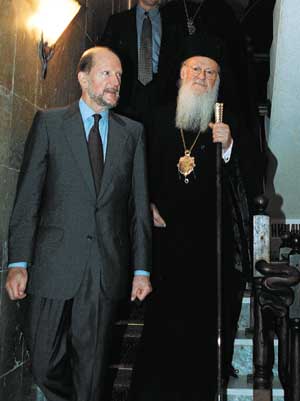
SOFIA, 2001 SEPT 08
On Sept. 8, the Feast Day of the Birth of Our MostHoly Mother of God
the Patriarchs of Bulgaria and Constantinople served jointly in Divine Liturgy at the 'Sveta Nedelya' cathedral in Sofia. Premier Simeon Saxe-Coburg-Gotha attended the service and
as usual read out the Credo and was the first to take holy communion.
After the service Premier Saxe-Coburg-Gotha and the two patriarchs spent a quarter of an hour in the side altar.
Then followed lunch by invitation of His Holyness Bulgarian Patriarch MAKSIM to His Allholyness Oecumenical Patriarch BARTHOLOMAIOS and His Majesty Premier SIMEON Saxe-Coburg-Gotha in the building of the Holy Synod.
In the afternoon Oecumenical Patriarch Bartholomaios received Premier Simeon Saxe-Coburg-Gotha in the presidential suite of the 'Hrankov' Palace hotel where he is residing. At the entrance he was welcomed by Metropolitan Emmanuel, representative of the Oecumenical Patriarchate at the European Institutions at Brussels, who led him to the suite of the Oecumenical Patriarch.
It is normal to talk about the schism in the Bulgarian Church, the prime minister said before the meeting. He, however, did not undertake to explain whether the government would launch any concrete measures to overcome it. After the one-hour meeting Premier Simeon Saxe-Coburg-Gotha specified he had been impressed by how much Bartholomew appreciated the Bulgarian Church. Under the aegis of His Holiness, very good possibilities lie ahead for all the Orthodoxy in general, the prime minister said. Over a cup of tea they also talked over travel plans of Patriarch Bartholomew I and a meeting between the premier and the Pope next year.
derived from an article by:
Anelia Basheva, Silvia Nikolova
in Bulgarian Daily Newspaper STANDART
" WE MADE EVERY EFFORT to BRIDGE the SCHISM "
Oecumenical Patriarch BARTHOLOMAIOS I:
"We hope the unity of the Bulgarian Orthodox Church to be restored because the schism is detrimental. Every effort has been made to bring the schism within the Bulgarian Church to its end. Mother Church is always willing to give a helping hand to all the churches like yours.
The Bulgarian Orthodox Church is the first-born and favourite daughter of the Oecumenical Patriarchate. Our expectations, prayers and wishes are that we soon celebrate its unity. This is our expectation, as well as the expectation of the entire Bulgarian people.
The presence of His Majesty, Bulgaria's Prime-Minister, and his good attitude towards the Bulgarian Orthodox Church and Patriarch Maxim raise our hope that the schism is soon to come to its end."
=======
PLOVDIV, 2001 SEPT 05
The Patriarch of Constantinopel BARTHOLOMAIOS is attending the Scientific Conference 'The Byzantine cultural heritage in the Balkans' which is held from Sept. 5 - 8 in the city of Plovdiv, Bulgaria.
His Allholyness was welcomed by Bulgarian Patriarch MAKSIM, Metropolitan ARSENIJ of Plovdiv and the Roman-Catholic Bishop Georgi Yovchev.
In Plovdiv Oecumenical Patriarch Bartholomew received a letter of greetings to the conference from Pope John Paul II :
'Today we should recall the Mission of the Holy Brothers Cyril and Methodius which is inseparable from Europe's cultural heritage,' the Pope writes. In the letter he calls for 'another evangelization of Europe', in order that it may return to its Christian roots. The address of Pope John Paul II was interpreted as a token of thawing relations between the Vatican and the eastern Orthodoxy.
In his speech the Oecumenical Patriarch Bartholomew stressed that today too, the Byzantine civilization should be an example of a peaceful co-existence in the Balkans and tolerance between the religions.
'In this way we could spare our troubled peninsula many of its present problems,' he pointed out.
After the opening of the conference Patriarch Bartholomew, Patriarch Maxim and Monsignor Georgi Yovchev prayed in the Plovdiv cathedral of Our Mostholy Mother of God for Bulgaria's well-being.
PLANNED VISIT of POPE JOHN-PAUL II:
JOHN PAUL II PLANS TO VISIT BULGARIA
IN 2002
ROME, AUG. 26, 2001 (Zenit.org).
John Paul II might visit Bulgaria next May, the country´s apostolic nuncio
said.
"The Holy Father will probably come in May, but the Vatican has not
yet confirmed it officially," said Archbishop Antonio Menini, following
a meeting in Sofia, the capital, with Bulgarian Foreign Minister Solomon
Passi on Wednesday. The Foreign Minister said that "the new Bulgarian government
supports the visit and will make the
greatest efforts" to receive the Pope.
BULGARIA - ROME 2001 03 15:
METROPOLITAN NEOPHYT of DOROSTOL-CERVEN speeks on position of ORTHODOX CHURCH of BULGARIA to INVITING the POPE to VISIT BULGARIA
On March 15 2001 Metropolitan NEOPHYT of Dorostol-Cerven spoke to bulgarian newspapers of his proposal to the formal position of the Bulgarian Orthodox Church to a visit of Pope JOHN PAUL II to Bulgaria. According to Metropolitan NEOPHYT
the program for this visit should be prepared by a joint commision of the
Bulgarian Orthodox Church and the Catholic Church "working synchronized
with the Bulgarian Government to give a good example of the hospitality of the Bulgarian
People and the Bulgarian Church".
When bulgarian statesmen of the past governments visited the Vatican in recent years and pronounced the usual invitations, Pope JOHN PAUL II had always responded positively, but also pointed out that an invitation by the Bulgarian Orthodox Church would be necessary as well.
Recently a visit to Sofia by Bishop Dr. JOSEF HOMEYER of Hildesheim (Germany)
organized by Monsignore Dr. NIKOLAUS WYRWOLL of the Catholic Institute for Eastern Churches in Regensburg encountered a favorable atmosphere for bilateral talks among the two churches.
For the Roman Catholic Church Bulgaria is linked to the commemoration of later Pope JOHN XXIII who had witnessed Orthodoxy during his years as Nuntius in Sofia. Primarily the Head of the Roman Catholic Church will see it as a pastoral visit to Bulgaria´s catholics organized since 1994 in 3 dioceses. (1 of byzantine and 2 of western Rite)
2 % of the bulgarian christians are catholics (approx. 90 % of western rite / 10 % of byzanine rite). Recently growing over 2 % are considered protestants (over 12 different registered denominations).
96 % of the Christians still are members of Bulgaria´s traditional Orthodox Church.
Alltogether christians today represent over 80 % of the Bulgarians.
PATRIARCH BARTHOLOMAIOS of CONSTANTINOPLE CALLS ON BULGARIANS:
"Be Open for Papal Visit"
"Reconciliation with the Catholic Church does not mean a decline in Orthodox dogmas."
copied from http://www.zenit.org/
SOFIA, Bulgaria, SEPT. 11, 2001 (Zenit.org):
Bulgarians should receive John
Paul II "without prejudice" if, as proposed, he visits the country next
year, said Bartholomew I, the Orthodox ecumenical patriarch of
Constantinople.
"How the Pope is welcomed will depend on the spiritual strength of members
of the local Church, but a respectful conduct without prejudice is certainly
the best," Bartholomew told Bulgaria's daily, "Troud", late last
week.
Apostolic Nuncio Antonio Menini said last month that the Pope might visit
Bulgaria next May, but the Vatican has not officially decided on the trip.
"If the faith of Bulgaria's Orthodox community is strong, then we have
nothing to be afraid of, whether it is the Pope or anyone else who is not
Orthodox," said Patriarch Bartholomew. "Reconciliation with the Catholic
Church does not mean a decline in Orthodox dogmas."
FORMER KING - First confessing CHRISTIAN ORTHODOX PRIME MINISTER of BULGARIA:
2001 July 24
BULGARIA:
FOR THE FIRST TIME SINCE 1944:
PRIME MINISTER speaks OATH OF SERVICE on BIBLE and CROSS
and asks the PATRIARCH for BLESSING
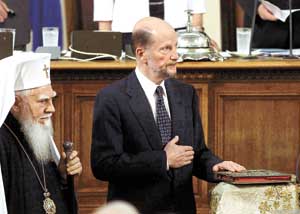
The newly elected Prime Minister of Bulgaria SIMEON SAKSKOBURGGOTSKI (Zar SIMEON II. of Bulgaria of the royal house of Saxony-Coburg and Gotha) is probably not only
the first King in history who had the courage to humbly accept to work for his country under a republican president but at the same time
he re-established christian traditions.
In Bulgaria, one of the oldest christian countries in Europe (more than 1200 years), none of the former prime ministers - no matter
if socialist or anti-communist - had the courage to confess his christianity and pledge his oath of service before the cross and his hand on the bible.
Following the oath SIMEON venerated the cross and the bible and asked the Bulgarian Patriarch MAKSIM for blessing before receiving the congratulations of the parlamentarians of his broad multiparty-coalition.
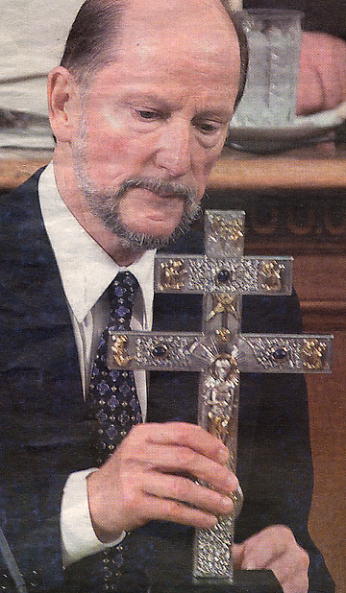
After the official state ceremony in the Parliament Building all newly sworn-in members of government went to the Cathedral, where Patriarch MAKSIM held a prayer service to ask God´s blessing for a successfull work to the benefit of the people of Bulgaria.
The Article of Bulgarian Newspaper STANDART gives the following details:
Bulgaria's Simeon, Ex-King Turned Prime Minister
by Anatoly Verbin
SOFIA, July 24 (Reuters) - Bulgaria's ex-King Simeon II, who became the Balkan state's prime minister on Tuesday, says a sense of duty to his motherland has forced him to enter politics at the age of 63.
"This choice is a turning point in my life and I will do all I can for the country and for every Bulgarian," he told parliament before it voted in his government.
"Today we are given a real chance to lead Bulgaria into the 21st century and take the place we deserve in the united Europe.
"This is the meaning of my life and the reason why I take this heavy responsibility."
"I am proud to be a Bulgarian."
The first ex-monarch to regain political power in post- communist eastern Europe, he turned 64 on June 16, one day before his National Movement for Simeon II won a parliamentary election in which he voted for the first time in his life.
A successful businessman in Spain, he entered politics only in April, after the Constitutional Court banned him from running for president.
Simeon Saxe-Coburg, whose huge estates across Bulgaria were confiscated by the communists and returned by the previous government, has consistently denied charges of his opponents that he wants to restore the monarchy.
Following explanations given by the internet publishers:
On Tuesday July 24 2001 SIMEON of Saxe-Coburg and Gotha gave a proof of courage by proposing to the parliament to revive the christian traditions of Bulgaria by demanding to pledge his oath of office on the bible in the presence of the Bulgarian Patriarch Maksim, the spiritual leader of 95 % of Bulgarians, who are of Christian Orthodox faith.
The members of parliament of the broad multiparty coalition that Simeon has gathered around him gave an overwhelming majority for this ceremony. 24 MPs from the former "anti-communist" government, with the former premier Ivan Kostov among them, voted 'against'. 17 MPs from the former ruling party, which clearly lost the elections and 2 MPs from the Socialist 'Coalition For Bulgaria' abstained.
After all the unique proceeding could become reality and -flanked by Orthodox Patriarch Maxim- Simeon swore an oath on the bulgarian constitution.
The tall, bald and bearded ex-monarch, who speaks several European languages fluently, won popularity on promises of a "new morality" in politics and pledges to uproot corruption.
After the ceremony in the parliament building the new cabinet walked to the "Alexander Nevski" cathedral, where Patriarch Maxim himself held a service for the success of the Premier and his ministers. Hundreds of citizens closely followed the ministers to the building of the Council of Ministers. They chanted "Simeon!" and "Many Years !".
ROYAL HISTORY
He will face huge popular expectations after his promise to improve living standards of the impoverished nation of eight million people within 800 days.
But to achieve that, he, and his inexperienced ministers will have to learn how to activate the levers of political power.
The son of King Boris III of the House of Saxe-Coburg and Queen Joanna of the House of Savoy, he is related to many European monarchs, including Britain's Queen Elizabeth.
His birth was marked by a 101-gun salute and an amnesty for prisoners and tax evaders.
He acceded to the throne at the age of six after his father's sudden death in 1943, ruling through a council of regency. He, his mother and sister Maria-Luisa fled Bulgaria after a rigged referendum abolished the monarchy in 1946.
The family first settled in Egypt. In 1951 the Spanish government granted them asylum.
At the age of 18, in Madrid, Simeon issued a proclamation re-affirming his commitment to the monarchy.
He is a graduate of the Valley Forge Military Academy in the United States.
Married to a Spanish aristocrat, Margarita, he gave Bulgarian names to his four sons Kardam, Kyril, Kubrat, Konstantin and daughter Kalina. They have all visited Bulgaria and Kyril is one of President Petar Stoyanov's advisers.
His late mother first returned to Bulgaria with Simeon's sister Maria-Luisa in 1993, receiving a tumultuous welcome as well as Simeon in his later visits.
Anelia Basheva
BULGARIA:
On SUNDAY´S Prime Minister SIMEON
regularly attends
CHURCH SERVICE
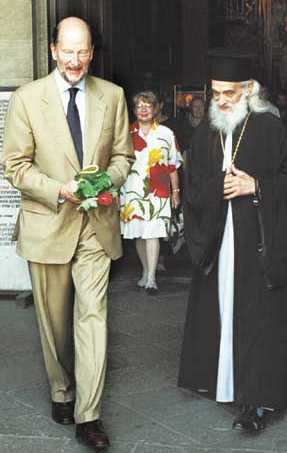
The newly elected Prime Minister of Bulgaria SIMEON SAKSKOBURGGOTSKI (Zar
SIMEON II. of Bulgaria - from the royal house of Saxony-Coburg and Gotha) is
giving another example of christian normality.
It is only natural for him to attend church service on sunday and on church
feast days. Now being the prime minister of the country and living in the capital
city Sofia he will thereby set standards for society.
When he last sunday attended church service in the cathedral this fact was
judged important enough for the most prestigous daily newspaper of Bulgaria to
publish an illustrated article.
Though in the St. Alexander Nevski Cathedral there is a representative place
for the tsar, where Simeon´s ancestors have attended service, the former tsar
now serving as prime minister was humble enough standing among the faithful for
the whole service, thereby creating a safety problem for his guards, who now
have become regular church goers themselves.
The second surprise for the public became visible, when polite church clergy at
the time of the creed thought it necessary to bring the text to the prime
minister. As the newspaper writes Simeon allready had pulled the text out of
the pocket of his jacket and was most naturally reading it with all the other
faithfull.
After he left the church with the serving patriarchal vicar bishop and renowned
church poet and author HILARION the crowd and journalists wanted Prime Minister
Simeon to adress the people. He did not give the political speach they
expected, but only explained that he was now on his way home to have lunch with
the family. Then he apologized to the bishop that despite the sunday he will
have to work in the afternoon to go through the 150 papers of the candidates
for vice ministers and provincial governors to give the country a working
government as soon as possible.
ARCHIVE:
FACTS - DOCUMENTS - ARTICLES
Christian Orthodoxy - worldwide
(german: To Front Page "Orthodoxe Fraternitaet in Deutschland"
DATA on Orthodox Churches WORLWIDE
Church NEWSLIST grouped by topics
see also: Christliche Verantwortung in der Welt - zu Politik und Krieg
EUROPE:
Christian Cooperation /
Defend Christian Cultural Heritage !
ORTHODOX CHURCHES:
Serbian /
RELATIONS:
State - Church /
church - church /
Internal Problems /
WITNESSING WORLDWIDE ORTHODOXY:
Europe /
Africa /
Asia - Far East /
>>> LIST of LATEST NEWS <<<
Listing of News originally in 4 languages of Christian Orthodox Press *SOP*, *OA* and World Wide Internet translated for you -
Links will lead you to our "Detail Page" -
If you miss a link / If you want to know more / Wenn Sie Information in Deutsch wollen => e-mail us and we will e-mail you back more
ORTHODOX@MyChurch.com

ORTHODOX@MyChurch.com
BULGARIA PORTUGAL 2001 03 03:
BLESSING OF FIRST ORTHODOX CHURCH BUILDING IN PORTUGAL MARKS SUNDAY OF ORTHODOXY IN LISSABON
BULGARIA ROME 2001 03 15:
METROPOLITAN NEOPHYT of DOROSTOL-CERVEN speeks on ORTHODOX CHURCH of BULGARIA INVITING the POPE to VISIT BULGARIA
EUROPE 2000 11 05 :
CARDINAL KöNIG URGES EUROPE TO SHOW MORE UNDERSTANDING IN INTEGRATION OF ITS ORTHODOX PART
EUROPE RUSSIA 2000 12 14 :
PATRIARCH ALEKSIJ POINTS OUT LACK OF CHRISTIAN VALUES IN EU CHARTA
GREECE ROME 2001 03 10:
ORTHODOX CHURCH of GREECE DECIDES to AGREE to INVITATION of the POPE
PRONOUNCED by GREEK GOVERNMENT
EUROPE 2001 01 26:
CHURCH ORGANISATIONS KEK and CCEE FINISH PREPARATION of CHARTA OECUMENICA
MOSCOW GENEVA 2001 02 14:
RUSSIAN ORTHODOX CHURCH in the WEST WILL BE UNITED SOON
MOSCOW CONSTANTINOPLE 2001 02 19:
TALKS to SETTLE PENDING CONFLICTS
CATHOLICS ORTHODOX 2001 01 26:
DEFENDING EUROPEAN RELIGIOUS CULTURAL HERITAGE IN HONORING TOGETHER an ICON of the MOTHER OF GOD
SOFIA 2001 02 02:
PROTESTS AGAINST POLITICIANS SUPPORTING "TWO or MORE BULGARIAN ORTHODOX CHURCHES" AGAINST THE ONLY OFFICIALLY IN ALL ORTHODOXY RECOGNIZED TRADITIONAL BULGARIAN ORTHODOX CHURCH of PATRIARCH MAKSIM
PARIS 2001 02 10:
PARISH of the THREE HOLY HIERARCHS: 70 year Jubilee
PARIS 2001 02 18:
ANNUAL REUNION of the ORTHODOX THEOLOGIC ACADEMIC INSTITUTE ST. SERGE
KOSOVO ATHENS 2001 01 22:
ARCHBISHOP CHRISTODOULOS VISITS KOSOVO and MEETS PATRIARCH PAVLE
KOSOVO USA 2001 02 12:
BISHOP ARTEMIJE MEETING WITH NEW US GOVERNMENT REPRESENTATIVES
SLOVAKIA 2001 01 28:
AGREEMENT to SETTLE DISPUTE BETWEEN ORTHODOX and GREEK-CATHOLICS
KIEV 2001 02 02:
ONLY OFFICIALLY IN ALL ORTHODOXY RECOGNIZED UCRAINIAN ORTHODOX CHURCH SENDS MESSAGES TO THE POPE AND THE OECUMENICAL PATRIARCHE TO POSTPONE VISITS
ORTHODOXIE AKTUELL 2001 / 2 (in german):
ATHENS 2001 01 25:
CONDITIONS for VISIT of POPE in GREECE are PROBLEMATIC
AFRICA 2001 02 09:
VISIT of PATRIARCH to ORTHODOX CHURCHES in NIGERIA and CAMERON
HONGKONG SINGAPUR 2001 01 06:
FIRST ORDONATION of ORTHODOX PRIEST (from SINGAPORE) in HONG KONG as part of CHINA
USA 2001 01 19:
ORTHODOX RELIEF ORGANISATION IOCC GRANTS HELP for VICTIMS of EARTHQUAKE in INDIA
DATA on Orthodox Churches worldwide

United in Faith, Prayer and Divine Service World-Orthodoxy consists of local churches as parts of the mystical body of Christ, with Christ as their only Lord and Master.
Their "Presiding Bishops" titled as Patriarchs, Archbishops or Metropolitans lead totally independently elected church administrations.
For consultations and coordination they may be called in for Holy Counsels by the Oecumenical Patriarch of Constantinople, who will preside as First among Equals.
in similar liturgical tradition but because of differences in interpretation of dogma not afiliated is the family of the "Old Oriental Churches"
(in brackets)
WORLDWIDE: about 177 Mio. + (41 Mio. Old Oriental Churches)
Patriarchate of Constantinople: 5 Mio. (mainly in worldwide diaspora: e.g. 1,5 Mio in USA)
Patriarchate of Alexandria: 15.000
Patriarchate of Antiochia: 500.000 (mainly in worlwide diaspora: e.g. 250.000 in USA)
Patriarchate of Jerusalem: 300.000
Russian Orthodox Church - Patriarchate of Moscow: 120 Mio.
Russian Orthodox Church - Outside Russia: 1, 5 Mio.
Serbian Orthodox Church: 11 Mio.
Roumanian Orthodox Church: 18 Mio.
Bulgarian Orthodox Church: 7 Mio.
Greek Orthodox Church: 9, 5 Mio.
(Coptic and Ethiopian Church: 37 Mio.)
Orthodox Church of Georgia - Patriarchate of Tbilissi: 2, 5 Mio.
(Armenian Apostolic Church: 2, 5 Mio.)
(Syrian Orthodox Church, also present in India: 1, 6 Mio.)
Orthodox Church of Cyprus: 600.000
and
Orthodox Churches of:
Albania: 500.000
Polonia: 900.000
America: 100.000
Finland: 60.000
Czech. Lands and Slowakia: 80.000
Japan: 30.000
...
Orthodox by country:
Nigeria: 10.000
Cameroun: 21 parishes
...
THE WORLDWIDE ORTHODOXY is GOVERNED by HOLY COUNCILS
(here the Roumanian, Cypriot, Bulgarian and Serbian Church representatives
during the All-Orthodox Council in St.Alexander Nevsky Cathedral, Sofia, Bulgaria)

(german: Orthodoxe Zusammenarbeit
(german: SYNDESMOS - Weltbund Orthodoxer Jugend
N E W S L I S T grouped by T O P I C S
EUROPE:
Christian Cooperation /
Defend Christian Cultural Heritage ! /
LOCAL ORTHODOX CHURCHES:
RELATIONS:
State - Church /
church - church /
Internal Problems /
WORLD ORTHODOXY:
Europe /
Africa - Far East /
EUROPE: COOPERATION of CHURCHES
EUROPE 2001 01 26:
CHURCH ORGANISATIONS KEK and CCEE FINISH PREPARATION of CHARTA OECUMENICA
EUROPE 2000 11 05 :
CARDINAL KöNIG URGES EUROPE TO SHOW MORE UNDERSTANDING IN INTEGRATION OF ITS ORTHODOX PART
CATHOLICS ORTHODOX 2001 01 26:
DEFENDING EUROPEAN RELIGIOUS CULTURAL HERITAGE IN HONORING TOGETHER an ICON of the MOTHER OF GOD
SLOVAKIA 2001 01 28:
AGREEMENT to SETTLE DISPUTE BETWEEN ORTHODOX and GREEK-CATHOLICS
DEFENDING the RELIGIOUS CULTURAL HERITAGE of EUROPE !
CATHOLICS ORTHODOX 2001 01 26:
DEFENDING EUROPEAN RELIGIOUS CULTURAL HERITAGE IN HONORING TOGETHER an ICON of the MOTHER OF GOD
EUROPE RUSSIA 2000 12 14 :
PATRIARCH ALEKSIJ POINTS OUT LACK OF CHRISTIAN VALUES IN EU CHARTA
EUROPE 2000 11 05 :
CARDINAL KöNIG URGES EUROPE TO SHOW MORE UNDERSTANDING IN INTEGRATION OF ITS ORTHODOX PART
STATE - CHURCH RELATIONS
BULGARIA ROME 2001 03 15:
METROPOLITAN NEOPHYT of DOROSTOL-CERVEN speeks on ORTHODOX CHURCH of BULGARIA INVITING the POPE to VISIT BULGARIA
SOFIA 2001 02 02:
PROTESTS AGAINST POLITICIANS SUPPORTING "TWO or MORE BULGARIAN ORTHODOX CHURCHES" AGAINST THE ONLY OFFICIALLY IN ALL ORTHODOXY RECOGNIZED TRADITIONAL BULGARIAN ORTHODOX CHURCH of PATRIARCH MAKSIM
CATHOLICS ORTHODOX 2001 01 26:
DEFENDING EUROPEAN RELIGIOUS CULTURAL HERITAGE IN HONORING TOGETHER an ICON of the MOTHER OF GOD
KOSOVO ATHENS 2001 01 22:
ARCHBISHOP CHRISTODOULOS VISITS KOSOVO and MEETS PATRIARCH PAVLE
KOSOVO USA 2001 02 12:
BISHOP ARTEMIJE MEETING WITH NEW US GOVERNMENT REPRESENTATIVES
KIEV 2001 02 02:
ONLY OFFICIALLY IN ALL ORTHODOXY RECOGNIZED UCRAINIAN ORTHODOX CHURCH SENDS MESSAGES TO THE POPE AND THE OECUMENICAL PATRIARCHE TO POSTPONE VISITS
ORTHODOXIE AKTUELL 2001 / 2 (in german):
ATHENS 2001 01 25:
CONDITIONS for VISIT of POPE in GREECE are PROBLEMATIC
cHURCH - cHURCH RELATIONS
SLOVAKIA 2001 01 28:
AGREEMENT to SETTLE DISPUTE BETWEEN ORTHODOX and GREEK-CATHOLICS
MOSCOW CONSTANTINOPLE 2001 02 19:
TALKS to SETTLE PENDING CONFLICTS
CATHOLICS ORTHODOX 2001 01 26:
DEFENDING EUROPEAN RELIGIOUS CULTURAL HERITAGE IN HONORING TOGETHER an ICON of the MOTHER OF GOD
KOSOVO ATHENS 2001 01 22:
ARCHBISHOP CHRISTODOULOS VISITS KOSOVO and MEETS PATRIARCH PAVLE
BULGARIA ROME 2001 03 15:
METROPOLITAN NEOPHYT of DOROSTOL-CERVEN speeks on ORTHODOX CHURCH of BULGARIA INVITING the POPE to VISIT BULGARIA
KIEV 2001 02 02:
ONLY OFFICIALLY IN ALL ORTHODOXY RECOGNIZED UCRAINIAN ORTHODOX CHURCH SENDS MESSAGES TO THE POPE AND THE OECUMENICAL PATRIARCHE TO POSTPONE VISITS
ORTHODOXIE AKTUELL 2001 / 2 (in german):
GREECE ROME 2001 03 10:
ORTHODOX CHURCH of GREECE DECIDES to AGREE to INVITATION of the POPE
PRONOUNCED by GREEK GOVERNMENT
ATHENS 2001 01 25:
CONDITIONS for VISIT of POPE in GREECE are PROBLEMATIC
INTERNAL cHURCH PROBLEMS
MOSCOW GENEVA 2001 02 14:
RUSSIAN ORTHODOX CHURCH in the WEST WILL BE UNITED SOON
SOFIA 2001 02 02:
PROTESTS AGAINST POLITICIANS SUPPORTING "TWO or MORE BULGARIAN ORTHODOX CHURCHES" AGAINST THE ONLY OFFICIALLY IN ALL ORTHODOXY RECOGNIZED TRADITIONAL BULGARIAN ORTHODOX CHURCH of PATRIARCH MAKSIM
WORLD ORTHODOXY: EUROPE
BULGARIA PORTUGAL 2001 03 03:
BLESSING OF FIRST ORTHODOX CHURCH BUILDING IN PORTUGAL MARKS SUNDAY OF ORTHODOXY IN LISSABON
PARIS 2001 02 10:
PARISH of the THREE HOLY HIERARCHS: 70 year Jubilee
PARIS 2001 02 18:
ANNUAL REUNION of the ORTHODOX THEOLOGIC ACADEMIC INSTITUTE ST. SERGE
WORLD ORTHODOXY: AFRICA
AFRICA 2001 02 09:
VISIT of PATRIARCH to ORTHODOX CHURCHES in NIGERIA and CAMERON
WORLD ORTHODOXY: ASIA - FAR EAST
HONGKONG SINGAPUR 2001 01 06:
FIRST ORDONATION of ORTHODOX PRIEST in HONG KONG as part of CHINA
USA 2001 01 19:
ORTHODOX RELIEF ORGANISATION IOCC GRANTS HELP for VICTIMS of EARTHQUAKE in INDIA
(german: Archiv: Nachrichten aus 1999 und davor
.
- Intra-Orthodoxe Kooperation -
.
SYNDESMOS
SYNDESMOS - Weltbund Orthodoxer Jugend: 50 Jahrjubiläum der Gründungsversammlung
Von 27.03. - 02.04. 1999 trafen sich Organisatoren orthodoxer Jugendbewegungen aus 19 Ländern in Bossey am Genfer See um am Gründungsort des Weltbunds der Orthodoxen Jugend SYNDESMOS über den bisherigen und den zukünftigen Weg dieser "weltweiten Koordination der orthodoxen Jugendbewegungen" nachzudenken. Von den jungen Leuten, die 1949 den Anfang gemacht hatten, und immer noch jugendlich engagiert wirken, waren Dr. Ioannis LAPPAS aus Athen und Velisar GAJIC aus Paris gekommen. Zusammen mit 2 SYNDESMOS-Vorsitzenden, Dr. Dimitri OIKONOMOU und Bischof DIMITRIOS von Xanthos, 4 SYNDESMOS-Generalsekretären, Vladimir MISIJUK, Alexander BELOPOPSKY, Gabriel HABIB und Anu TALVIVAARA, und 2 SYNDESMOS-Stellvertretenden-Vorsitzenden, Manos KOUMBARELIS und Vater JOHN MATUSIAK stellte Dr. LAPPAS namens der Gründer fest, dass SYNDESMOS auch nach 50 Jahren noch nichts vom Schwung der Anfangszeit verloren hat und die besten Chancen hat, in der inzwischen deutlich veränderten Welt neue Dienste für die orthodoxe Jugend und die Einheit der Orthodoxie in aller Welt zu leisten.
SYNDESMOS "Band der Einheit im Geiste" (Eph. 3,4: "Erstrebt die Einheit im Geiste durch das Band des Friedens (=griech. syndesmos)" ist der Weltbund Orthodoxer Jugend, 1953 gegründet umfaßt er heute 118 Mitglieds-Organisationen in 41 Ländern in aller Welt. Ziel von Syndesmos ist Verständigung und Zusammenarbeit zwischen orthodoxen Jugendbewegungen und theologischen Lehranstalten in aller Welt zu unterstützen und ein tieferes Verständnis für den gemeinsamen Glauben fördern.
Vorsitzender: Dr. Dimitri Oikonomou
Generalsekretär: Vladimir Misijuk
Adresse:
SYNDESMOS General-Sekretariat
PO Box 22, P - 15-950 BIALYSTOK, POLEN
+48 85 6534 884 / Fax: +48 85 6543 747
e-mail: syndesmos@bianet.com.pl
im INTERNET:
http://www.syndesmos.org.pl
.
- Intra-Orthodoxe Kooperation -
Orthodoxe Theologische Institute - institutionelle Zusammenarbeit im Aufbau
Mit dem Segen Seiner Heiligkeit Patriarch ALEKSIJ II von Moskau und ganz Russland fand vom 20.- 26 Januar 1999 eine von Syndesmos organisierte Internationale Konsultation Orthodoxer Theologischer Lehranstalten in der St.Petersburger Theologischen Akademie statt.
In dieser 7.Konsultation wurde der Versuch unternommen unter den orthodoxen theologischen Lehranstalten, von denen allein 30 Mitglieder von Syndesmos sind, mit dem Aufbau einer weltweit institutionalisierten Zusammenarbeit zu beginnen. Das grosse Interesse daran kam in der bisher höchsten Beteiligung an einer Konsultation zum Ausdruck: 45 Lehranstalten aus 17 Ländern waren durch 75 Repräsentanten vertreten. Dazu kamen weitere 30 Vertreter orthodoxer Jugend- und Bildungsorganisationen.
Zu den Teilnehmern sprachen:
Seine Exzellenz, der Hochgeweihte KONSTANTIN, Bischof von Tikhvin, Rektor von St.Petersburger Akademie und Seminar: "Kirche, Liturgie und Bildung"
Priestermönch HILARION (Alfejev), Moskau: "Christliche Bildung im Osten"
Vater RAUNO Pietarinen, Ilomantsi, Finnland: "Orthodoxe Bildung: Kontinuität von Jugenddiensten und religiöser Bildung im Gemeindeleben"
Dr. Athanassios PAPATHANASSIOU, Athen, Griechenland: "Die Sprache der Kirche - Die Sprache der Welt: Abenteuer der Kommunikation oder Konflikt"
Vater VLADIMIR Fedorov, St.Petersburg: "Orthodoxe Sendung und die Moderne Welt"
Igumen ALEXANDER Fedorov, St.Petersburg: "Christliche Kunst und die Sendung der Kirche"
Vater KIRILL Kopeikin: "Wechselwirkungen zwischen Theologischer und Weltlicher Bildung"
Zahlreiche Initiativen zeigten das Interesse am Aufbau organisierter Zusammenarbeit:
- Herausgabe eines jährlich aktualisierten Verzeichnis Orthodoxer Theologischer Lehranstalten (ca. 100 weltweit)
- Jährliche Biographien der Fakultätsmitglieder aller Orthodoxer Theologischer Lehranstalten mit ihren wissenschaftlichen Veröffentlichungen
- Koordination von Professoren- und Studentenaustausch
- Konsultationen und öffentlichen Konferenzen zu spezifischen Fragen
- Unterstützung von Lokalen und Regionalen Treffen Orthodoxer Theologischer Lehranstalten
- Benennung einer Kontaktperson aus jeder Lehranstalt zum Aufbau der neuen Vereinigung
- Aufstellung eines Kommittees zur Lenkung der Arbeit der neuen Vereinigung
- Benennung eines haupt- oder nebenamtlichen Sekretariatsmitarbeiters bei Syndesmos zur Koordination der Aktivitäten der neuen Vereinigung
.
Orthodoxe Journalisten - Internationaler Verband in Gründung
Eine einwöchige Konferenz orthodoxer Persönlichkeiten aus der Welt der Medien fand vom 16. - 23. Mai in Volos, Griechenland statt und beschloss die Gründung einer INTERNATIONALEN VEREINIGUNG ORTHODOXER JOURNALISTEN. 75 Journalisten und Pressesprecher orthodoxer kirchen aus 23 Ländern tagten auf Einladung von Syndesmos und dem Metropoliten IGNATIOS von Demetrias unter dem Vorsitz von Vater JOHN Matusiak, Stellv.Vorsitzender von Syndesmos und Communications Director der Orthodoxen Kirche in Amerika.
Andrei ZOLOTOV von der Moscow Times, Antoine NIVIERE von der in Paris beheimateten Institution "Service Orthodoxe de Presse", und Liana KANELLI und Dr. Angelos VALIANATOS aus Griechenland hielten die Hauptreferate.
In den Diskussionen wurde immer wieder die Aufmerksamkeit auf die Notwendigkeit einer starken orthodoxen Präsenz im Internet gelenkt.
Zur Gründung der INTERNATIONALEN VEREINIGUNG ORTHODOXER JOURNALISTEN wurde eine Arbeitsgruppe gebildet, die einen Lenkungsausschuss zur Organisation der erforderlichen Aktivitäten bestimmte. Der "Kerngruppe" gehören Andrei ZOLOTOV, Jean TCHEKHAN, Vater APOSTOLOS Forlides, Konstantinos TSILIS und Vater JOHN Matusiak an.
Besuche bei orthodoxen Medien und Radiosendern in Griechenland ergänzten das Programm.
Als Höhepunkt und bestmöglichen Startimpuls für die weitere Arbeit sehen die orthodoxen Journalisten in dem persönlichen Segen den ihnen Seine Allheiligkeit der Oekumenische Patriarch BARTHOLOMäOS nach einer gemeinsamen Verehrung der Gebeine des Hl. NEKTARIOS auf AEGINA gab.
SOP - Service Orthodoxe de Presse
ist eine Monatsschrift in französischer Sprache, die ihre Leser regelmässig und umfassend über das Leben der orthodoxen Kirche in Frankreich und in der Welt informiert und die aktuellen Ereignisse reflektiert. SOP stellt sich unter die Auspizien der Versammlung der Orthodoxen Bischöfe Frankreichs und ist ein Dienst der von der Orthodoxen Fraternität in Westeuropa sichergestellt wird.
Abonnements und Dokumentation: sopdoc@micronet.fr
Adresse: 14, rue Victor-Hugo, F - 92 400 COURBEVOIE, FRANCE
+ 33 (0)1 43 33 52 48 Fax: +33 (0)1 43 33 86 72
SOP im INTERNET:
http://www.orthodoxpress.com
*OA*
ORTHODOXIE AKTUELL
Informationsdienst der KOKiD (Deutschland)
bestellbar bei: Heinkelstr. 8, D-42285 Wuppertal, Fax 0202-282 52 30
Email: KOKID_OA@compuserve.com
120.- DM / Jahr
Orthodoxie aktuell
AKTUELLES:
Kalender |
Nachrichtenarchiv |
Ikonen und Texte zum Fest im Jahreskreis |
ZEITLOSES:
Unser Zugang zu Gott |
Unsere Gottesdienste |
kirchenGEMEINSCHAFT:
Geistliche, Gemeinden |
Fraternität |
In Mem.V.SERGIUS |
LINKS/Bücher |
F&A |
Jugend
KLOESTER:
Hl.BERG ATHOS / Bulgarien |
Hl.Spyridon/Lahn |
Allhl.Dreifaltigkeit/Buchhagen
Orthodoxe Fraternitaet in Deutschland
e.V.
Bonner Str. 358, D-50968 Koeln, Deutschland
(Germany)
ORTHODOX@MyChurch.com
ORTHODOX@MyChurch.com


